
Property Types: A Guide to Residential Options and Key Decisions
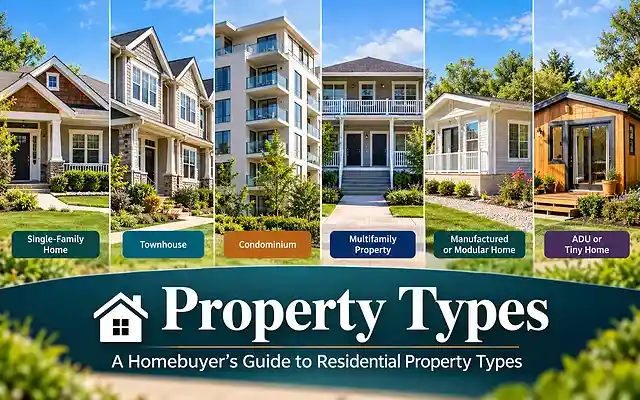
Understanding property types is an important part of buying a home because different properties can involve substantially different ownership rights, maintenance responsibilities, financing requirements, and living arrangements.
A detached single-family house, townhouse, condominium, duplex, cooperative apartment, and manufactured home may all provide residential accommodation. However, their similarities do not necessarily extend to who owns the land, who maintains the building, how shared expenses are handled, or which restrictions apply.
For homebuyers in the United States, choosing between property types requires more than comparing square footage, appearance, or asking prices. The physical structure, legal ownership arrangement, property condition, location, and recurring expenses all influence what ownership will involve.
This guide explains the major residential property types, their defining characteristics, potential advantages, limitations, and practical considerations. It also examines how property classifications affect ownership, financing, insurance, maintenance, and the process of comparing homes.
By understanding these differences, buyers can identify suitable options, recognize important questions, and make more informed decisions about individual properties.
What Are Property Types in Real Estate?
Property types are classifications used to distinguish real estate according to its use, structure, ownership arrangement, construction method, or other defining characteristics.
The meaning depends on the classification system being used.
In real estate listings, properties may be grouped into residential, commercial, land, residential income, or other categories. These classifications help buyers, sellers, and real estate professionals organize available properties.
For example, the California Regional Multiple Listing Service’s property-type classifications distinguish different transaction and listing categories. Other multiple listing services may use different definitions and subcategories.
For someone purchasing a home, however, the listing classification is only the beginning.
Two properties described as residential may involve very different legal ownership interests, building arrangements, financial obligations, and maintenance responsibilities.
The main ways properties are classified
A useful approach is to distinguish five characteristics.
| Classification | What it describes | Examples |
|---|---|---|
| Property use | The primary purpose or designated use of the real estate | Residential, commercial, agricultural, mixed-use |
| Physical structure | How the dwelling is arranged and built | Detached house, townhouse, duplex, apartment building |
| Ownership arrangement | What legal interest the buyer acquires | Fee-simple ownership, condominium interest, cooperative shares |
| Construction method | How the dwelling was constructed | Site-built, manufactured, modular |
| Architectural style | The building’s appearance and design characteristics | Ranch, Colonial, Craftsman, Victorian |
These classifications are not mutually exclusive.
A property could be a detached single-family residence, constructed using modular methods, owned within a condominium development, and designed in a Craftsman architectural style.
Each description identifies a different characteristic of the same property.
The U.S. Census Bureau’s housing construction definitions illustrate why classification context matters. Statistical definitions may distinguish physical structures, construction methods, condominium ownership, and cooperative housing according to the purpose of the data.
A listing label should therefore not be treated as a complete explanation of the property.
Residential versus commercial and other property types
Residential properties generally provide housing for individuals or households. Common examples include detached homes, attached homes, condominiums, and multifamily dwellings.
Commercial properties generally relate to business use, although specific classifications depend on applicable regulations and listing practices.
Industrial, agricultural, vacant-land, and mixed-use properties represent additional categories. A mixed-use building, for example, may contain apartments above retail or office space.
Although these broader classifications are useful, this guide focuses on residential properties relevant to people looking for a primary residence, secondary home, or other personal housing arrangement.
Single-Family Detached Homes
A single-family detached home is a standalone residential building that does not share walls with another dwelling.
It commonly occupies an individual lot and provides living space intended for one household.
Detached homes can include one-story houses, two-story properties, homes with basements, and residences with attached or detached garages.
Their characteristics vary significantly according to age, construction, lot size, location, and design.
Potential advantages of detached homes
Detached housing often provides greater physical separation from neighboring dwellings.
Depending on the property, possible benefits include private outdoor areas, additional storage, flexible layouts, and greater control over certain maintenance and improvement decisions.
Some homes provide space for gardens, workshops, outdoor activities, or future additions where permitted.
The absence of shared walls may also reduce certain concerns associated with attached housing. However, privacy depends on more than property type.
A detached house on a narrow lot may be closer to neighboring homes than an attached residence designed with substantial separation between living spaces.
Likewise, a detached property does not necessarily provide unrestricted control over the land.
Maintenance and ownership responsibilities
Detached homeowners often arrange and pay directly for maintenance of roofing, siding, foundations, landscaping, drainage, driveways, and major building systems.
These responsibilities can involve substantial time and financial commitments.
An older detached property may need repairs or replacements that are not immediately obvious from its appearance.
Homeowners associations can also govern detached-home developments. Association rules may affect exterior alterations, landscaping, parking, and other property uses.
What buyers should verify: Determine whether the land is included in the transaction, whether association restrictions apply, and which major building components may require maintenance or replacement.
Detached housing may provide additional independence, but that independence frequently comes with greater direct responsibility for property care.
Townhouses and Attached Single-Family Homes
A townhouse generally describes a dwelling attached to one or more neighboring residences through shared walls.
Townhouses commonly have individual entrances and may contain multiple floors, garages, patios, or small yards.
Some developments feature rows of similarly designed homes, while others include varied arrangements.
Living in an attached property
Attached housing can provide substantial living space within neighborhoods that use land more efficiently than areas dominated by widely separated houses.
Potential advantages include convenient locations, manageable private outdoor areas, and access to community facilities.
However, attached living introduces considerations involving shared walls, sound transmission, parking, entrances, and outdoor privacy.
These conditions vary by construction and layout. An attached residence should be evaluated individually rather than judged solely by its property classification.
Townhouse ownership is not always the same
One of the most important distinctions is that a townhouse is primarily a physical housing form.
A townhouse-style dwelling may be owned together with an individual lot, or it may be part of a condominium ownership arrangement.
The difference can affect responsibility for roofing, exterior walls, landscaping, shared facilities, and insurance.
For example, an owner may be responsible for maintaining the entire exterior of one townhouse, while another development may assign specific exterior responsibilities to an association.
Both properties could look nearly identical.
What buyers should verify: Examine the legal description and governing documents to establish what is owned individually, what is shared, which restrictions apply, and who maintains major components.
If you are comparing these arrangements, our Condo vs Townhouse guide explains how ownership, association responsibilities, insurance, and costs can differ.
Condominiums
A condominium, commonly called a condo, is principally a form of property ownership rather than a particular architectural design.
A condominium owner holds a legally defined interest in an individual unit together with associated rights or interests involving common elements, as established by applicable law and governing documents.
Condominiums can exist in high-rise buildings, small residential complexes, townhouse-style developments, and certain detached-home communities.
How condominium ownership works
Condominium developments commonly distinguish individually owned property from shared or common elements.
Common elements may include hallways, elevators, landscaped grounds, recreation facilities, roofs, exterior components, or other designated areas.
The exact division varies. A condominium association usually administers specified shared responsibilities and collects money from owners to fund operating expenses, maintenance, insurance, reserves, and other obligations.
The Fannie Mae guide to buying a condominium highlights the importance of examining the condominium community and its financial arrangements, not simply the individual unit.
A condominium purchase therefore involves evaluating both a home and the legal and financial structure supporting the wider development.
Potential advantages of condominium living
Some condominium owners appreciate having designated common-area maintenance coordinated through an association.
Shared amenities, access to urban locations, and smaller private living spaces may also appeal to particular households.
A condominium can be practical for someone who prefers not to arrange every aspect of exterior property maintenance independently.
However, services and responsibilities differ between communities. Association management does not mean an owner has no maintenance obligations.
Costs, restrictions, and financial considerations
Condominium ownership may involve regular association dues, special assessments, and expenses associated with maintaining the individual unit.
An association facing major repairs or insufficient reserves may need to collect additional money from owners. Community rules can also affect pets, rentals, exterior alterations, parking, and use of common areas.
Mortgage financing may require review of condominium-project characteristics as well as the individual buyer’s financial qualifications.
What buyers should verify: Review the declaration, bylaws, association budget, reserve information, insurance arrangements, known assessments, major repair plans, and any restrictions affecting intended use.
A lower purchase price does not automatically mean lower overall ownership costs.
Cooperative Housing
Cooperative housing, commonly called a co-op, involves an ownership arrangement different from a typical condominium.
Instead of purchasing conventional title to an individual dwelling, a buyer generally acquires shares or a membership interest in an organization that owns the property.
Those shares are associated with rights to occupy a particular residential unit under the cooperative’s governing arrangements.
How cooperative ownership affects residents
A cooperative organization generally owns the underlying real estate.
Residents may pay monthly charges that support building operations, maintenance, property-related expenses, financing obligations, and other costs.
The exact financial arrangement depends on the cooperative.
Cooperatives may establish requirements concerning purchases, occupancy, transfers, subletting, renovations, and other activities.
Because these rules affect ownership and use, buyers should understand them before committing to a purchase.
Financial and practical considerations
A cooperative purchase requires evaluation of the residential unit and the organization itself.
Important questions concern the cooperative’s financial condition, underlying debt, monthly charges, ownership rights, approval procedures, and restrictions on future transfers.
Financing may also differ from conventional mortgage arrangements because the buyer’s ownership interest is structured differently.
What buyers should verify: Establish precisely what the purchased shares convey, what financial obligations accompany them, and which approval or transfer requirements apply.
A cooperative may provide desirable housing, but its legal and financial structure should not be assumed equivalent to condominium ownership.
Duplexes, Triplexes, and Fourplexes
Small multifamily properties contain multiple residential units within one building or property arrangement. Common examples include duplexes with two units, triplexes with three, and fourplexes with four.
The precise classification used for lending, zoning, building statistics, or local records may depend on the physical arrangement and applicable definitions.
Owner-occupancy possibilities
Some buyers consider small multifamily properties because they want to occupy one unit while renting another.
Others may seek separate living spaces for relatives or multiple households. When legally permitted and appropriately configured, these arrangements can offer flexibility.
Rental income may help offset certain ownership expenses, but it is not guaranteed. Vacancies, nonpayment, repairs, management, insurance, utilities, and other costs can affect actual financial results.
Responsibilities associated with multiple units
Multifamily ownership can introduce obligations involving tenants, leases, maintenance requests, common areas, utility arrangements, and repairs that affect more than one household.
Owners should understand applicable landlord-tenant requirements. The legality of each residential unit also matters.
A basement converted into an apartment, for example, is not necessarily an authorized independent dwelling simply because it contains a kitchen and bathroom.
Financing and legal-use considerations
Mortgage requirements can differ according to the number of dwelling units, occupancy plans, property characteristics, and loan program.
Lenders may assess proposed rental income under specific eligibility rules rather than accepting an advertised amount.
What buyers should verify: Confirm the property’s legally recognized unit configuration, applicable rental permissions, physical condition, financing requirements, and realistic operating expenses.
A multifamily property should be evaluated as both housing and a potentially more complex ownership responsibility.
Apartments and Apartment-Style Properties
An apartment generally describes an individual residential unit within a larger building. However, the term does not establish one universal legal ownership arrangement.
An apartment may be rented, individually owned as a condominium, occupied through cooperative rights, or located in a building owned by a single landlord.
Why the distinction matters
The physical appearance of an apartment does not determine what a resident owns.
A renter generally occupies the unit under a lease, subject to applicable law and contractual terms.
A condominium owner holds a legally defined ownership interest.
A cooperative resident typically holds shares or membership rights associated with occupancy.
The building may look similar under each arrangement.
What buyers should verify: Determine whether the transaction involves an individually owned unit, cooperative interest, entire multifamily property, or another legal arrangement.
The word apartment alone is insufficient to establish ownership rights, maintenance responsibilities, or financing requirements.
Manufactured Homes
Manufactured homes are factory-built dwellings constructed under federal Manufactured Home Construction and Safety Standards administered by the U.S. Department of Housing and Urban Development.
They are constructed using a regulated manufacturing process and transported to their installation location.
Modern manufactured housing should not automatically be confused with older dwellings casually described as mobile homes.
The U.S. Department of Housing and Urban Development’s manufactured housing resources explain important construction, installation, purchasing, and homeowner considerations.
Construction and installation
Manufactured homes are built in factories and transported for installation at their intended sites.
They are constructed on a permanent chassis and must meet applicable federal manufactured housing requirements.
Installation conditions, foundation arrangements, utility connections, and local requirements remain important after the home leaves the factory.
A buyer should evaluate the completed installation rather than focusing exclusively on the factory construction process.
Why land ownership matters
A manufactured home may be situated on land owned by the homeowner or on a rented lot within a manufactured-home community.
These arrangements can have substantially different financial and legal consequences.
When the buyer owns the home and land together, the transaction may involve obligations associated with maintaining both.
When the homeowner leases the lot, continuing costs may include lot rent and other community charges.
Lease provisions, rules, and transfer conditions may affect future flexibility.
Financing considerations
Financing can depend on the home’s classification, title, age, condition, installation, land arrangement, and applicable lender requirements.
Not every manufactured home qualifies for the same financing product.
Insurance and community obligations may also require additional review.
What buyers should verify: Confirm whether the land is included, how ownership is documented, whether the installation meets applicable requirements, and what recurring expenses will continue after purchase.
The advertised purchase price of a manufactured home should never be evaluated without understanding the land arrangement.
Modular Homes
Modular homes are constructed using factory-produced sections that are transported to a building site and assembled into a completed dwelling.
Unlike HUD-code manufactured homes, modular homes are generally constructed under the state or local building codes applicable at their installation location.
This distinction concerns construction standards and methods rather than architectural appearance.
What modular construction means
A modular home may resemble a conventionally built detached house once completed.
It can contain multiple floors, a garage, a basement, or other features commonly associated with site-built housing.
Although the modules are produced in a factory, the completed project still depends on land preparation, foundations, transportation, installation, utility connections, and inspections.
Potential benefits and limitations
Factory production can offer a controlled construction environment and may allow some work to proceed while site preparation takes place.
However, transportation logistics, site conditions, building requirements, and project coordination can affect the schedule and total cost.
A modular home should not automatically be assumed cheaper or faster to complete than every site-built alternative.
What buyers should verify: Review the total project scope, land ownership, foundation work, applicable building-code compliance, completion arrangements, financing, and warranties.
The appropriate comparison is between completed properties and actual project obligations, not simply factory-built versus site-built labels.
Accessory Dwelling Units
An accessory dwelling unit, commonly called an ADU, is generally a secondary residential unit associated with a primary property.
Depending on local definitions, examples may include backyard cottages, converted garages, attached secondary suites, and basement apartments.
ADUs can provide additional household flexibility and, where permitted, potential rental accommodation.
How ADUs affect residential ownership
An ADU is not automatically a separately owned or separately transferable property.
Its legal status depends on applicable zoning, permits, parcel arrangements, ownership rules, and local requirements.
A detached backyard cottage does not necessarily represent a separate legal lot.
Similarly, an interior space with a kitchen and bathroom is not necessarily approved as an independent residential unit.
Evaluating a property with an ADU
Buyers should investigate whether the unit is permitted, how it may lawfully be used, and whether rental restrictions apply.
Utility arrangements, access, maintenance, insurance, and the condition of the additional dwelling also matter.
What buyers should verify: Establish the unit’s legal status, approved use, required permits, and whether the property can support the household’s intended plans.
Rental potential should not be assumed solely from the seller’s description.
Tiny Homes and Other Small Dwellings
Tiny homes generally refer to very small residential dwellings. However, the term does not establish one uniform national legal, construction, or ownership category.
A tiny home might be site-built, modular, manufactured, or constructed on a movable chassis. The requirements affecting each arrangement may differ.
Land, zoning, and occupancy
A small dwelling’s ability to serve as a permanent residence can depend on zoning, minimum building standards, foundations, utilities, permits, and local occupancy requirements.
A tiny home on wheels may raise additional questions concerning vehicle classification and permitted residential use.
Owning the structure does not necessarily mean the owner has a lawful place to install or occupy it.
Practical living considerations
Small dwellings may reduce the space available for storage, work, guests, and changing household needs.
An efficient layout can make a compact home functional, but suitability depends on the occupants’ requirements.
What buyers should verify: Confirm the dwelling’s legal classification, permitted installation location, occupancy status, utilities, insurance, and financing options before relying on its advertised price or intended use.
Property Characteristics That Are Not Separate Ownership Types
Several descriptions commonly used in residential listings can create confusion because they identify something other than a distinct legal ownership category.
Understanding these descriptions helps buyers compare properties accurately.
Architectural styles
Ranch, Colonial, Craftsman, Victorian, Tudor, Cape Cod, and contemporary designs describe architectural characteristics.
They may indicate roof shapes, exterior materials, room arrangements, proportions, or other design features.
However, a Ranch-style house is not necessarily subject to a different ownership arrangement from a Colonial-style house.
Architectural style may affect maintenance, accessibility, and personal preference without determining legal title or association obligations.
New construction versus existing homes
New construction describes a property’s construction status rather than its basic residential ownership type.
A newly constructed property could be a detached house, townhouse, condominium, or another dwelling.
New construction may involve builder contracts, construction schedules, warranties, inspections, and completion requirements.
Existing homes require evaluation of current condition, previous repairs, alterations, and maintenance history.
The distinction affects the buying process, but it does not replace the underlying property classification.
Single-story versus multi-story homes
The number of floors describes a building’s layout.
Single-story and multi-story arrangements can occur across several residential property types.
Accessibility, stairs, maintenance, and space utilization may influence household preferences.
However, the number of floors does not establish the legal ownership structure.
To explore how building forms, construction methods, and design descriptions differ, see our Types of Homes guide.
Comparing Property Types Based on Important Buyer Decisions
A property classification becomes most useful when it helps you identify what requires further investigation.
Rather than assuming one housing type is universally better than another, compare the actual property against your household’s priorities.
Property-type decision matrix
| Buyer decision | Why property type matters | What to verify |
|---|---|---|
| Privacy and separation | Shared walls, entrances, and common spaces vary | Layout, construction, neighboring units, and outdoor areas |
| Maintenance responsibilities | Direct owner duties and association obligations differ | Governing documents, repair history, and maintenance allocation |
| Land ownership | A dwelling purchase does not always include land ownership | Title, legal description, ground lease, or lot-rental agreement |
| Monthly affordability | Dues, assessments, lot rent, and maintenance costs vary | Mortgage estimate, taxes, insurance, fees, and property-specific expenses |
| Financing eligibility | Some ownership and construction arrangements require additional review | Lender requirements, property condition, and loan-program eligibility |
| Renovation flexibility | Ownership rights and community rules may restrict alterations | Permits, association requirements, and applicable regulations |
| Rental opportunities | Multiple units or accessory spaces may have legal restrictions | Zoning, authorized occupancy, rental rules, and realistic operating costs |
| Future accessibility | Stairs, entrances, and shared facilities affect daily use | Actual layout, accessibility features, and permitted modifications |
The matrix is a practical comparison framework, not a ranking of property types.
A detached property may offer greater control over certain repairs but require more direct maintenance.
A condominium may coordinate designated shared responsibilities but introduce additional financial and organizational obligations.
A small multifamily property may accommodate multiple households but require more extensive management.
The appropriate choice depends on the specific property, its documented conditions, and the buyer’s circumstances.
Consider space and privacy
Square footage alone does not establish how comfortably a home will function.
A well-designed attached property may offer efficient living space, while a detached home with an awkward layout may provide less usable room than expected.
Evaluate room arrangements, storage, outdoor areas, parking, sound transmission, and shared facilities. Privacy also depends on the physical surroundings and construction.
Consider maintenance capacity
Homeownership requires time, money, or both to maintain a property. Some buyers prefer direct control over exterior repairs and landscaping.
Others may prefer arrangements where specified work is coordinated collectively.
An association does not eliminate maintenance expenses. It changes how certain responsibilities are administered and funded.
Review the actual obligations before assuming one property category is easier or cheaper to maintain.
Consider household needs over time
A property’s suitability can change as household circumstances evolve.
Stairs, accessibility, parking, room arrangements, workspaces, storage, and outdoor areas may become more or less important.
Buyers who anticipate future alterations should confirm whether those changes would be permitted.
The objective is not to predict every future circumstance but to avoid overlooking important practical limitations.
How Property Types Affect Homeownership Costs
Purchase price is only one component of affordability.
Two properties with similar asking prices may have substantially different ongoing expenses because of their ownership arrangements, maintenance responsibilities, and community obligations.
Mortgage payments, taxes, and insurance
Typical ownership costs may include mortgage principal and interest, property taxes, homeowners insurance, and mortgage insurance where applicable.
Additional expenses may include utilities, association dues, land rent, maintenance, and repairs.
The Consumer Financial Protection Bureau explains that condominium, cooperative, and HOA fees are usually separate from the mortgage-servicer payment.
Therefore, a quoted mortgage payment should not be mistaken for the complete monthly cost of owning a property.
Association dues and special assessments
An association may collect regular dues to support shared maintenance, insurance, management, utilities, reserves, and other designated expenses.
Additional assessments may be required under the governing documents and applicable law.
A low association fee does not automatically mean a development has fewer financial obligations.
Buyers should investigate the association’s financial condition and known major projects rather than evaluate the monthly payment alone.
Direct maintenance expenses
Owners of detached properties may need to arrange and finance roofing, exterior repairs, landscaping, and other work independently.
Owners of attached or condominium properties may contribute to some shared expenses through associations while remaining directly responsible for designated components.
The financial consequences depend on what requires repair and how the costs are allocated.
Land-related expenses
A property situated on leased land may involve ongoing payments separate from the purchase price of the dwelling.
Manufactured-home communities are one setting where lot rent may be relevant.
Lease terms, potential increases, transfer restrictions, and community requirements can influence future expenses and flexibility.
Evaluating affordability realistically
Suppose a buyer compares a detached house with a condominium. The detached property has no condominium dues but requires substantial roof repairs.
The condominium has monthly dues covering designated common expenses, but the association has identified a major future building project.
Comparing only the mortgage payments would overlook significant information.
A more complete analysis examines the purchase price, financing, insurance, taxes, association obligations, anticipated repairs, and other property-specific costs.
Neither property category automatically establishes greater affordability.
How Property Types Affect Mortgage Financing
Mortgage financing depends on the borrower, loan program, lender, and characteristics of the property.
A particular residential ownership or construction arrangement may require additional documentation or eligibility review.
Detached and attached properties
Detached and attached homes may qualify for conventional residential financing when applicable requirements are satisfied.
However, property condition, legal title, construction, appraisal, and intended occupancy can influence approval.
A townhouse-style dwelling held under condominium ownership may be evaluated differently from another townhouse with a different legal arrangement.
Condominiums and cooperatives
Condominium financing may involve reviewing the development’s financial, legal, and project characteristics.
Cooperative financing may involve requirements associated with purchasing shares or another cooperative ownership interest.
Approval for one property does not automatically establish financing eligibility for another.
Multifamily properties
Properties containing multiple dwelling units may be subject to financing rules involving the number of units, occupancy, rental income, and property use.
A buyer intending to occupy one unit should communicate that accurately.
Projected rental income may be evaluated according to lender and loan-program requirements rather than accepted at its advertised amount.
Manufactured and modular properties
Manufactured housing can involve requirements relating to classification, installation, foundation, title, land ownership, and property condition.
Modular housing may involve different evaluation requirements depending on its completed condition, code compliance, and ownership arrangement.
The actual lender and loan program determine applicable eligibility standards.
Comparing mortgage estimates
The CFPB’s Loan Estimate explainer explains how borrowers can examine mortgage terms, estimated payments, closing costs, and other financing information.
When comparing properties, obtain information based on their actual characteristics rather than assuming that a financing estimate for one type of home applies unchanged to another.
Property Insurance and Maintenance Responsibilities
Property insurance and maintenance obligations can differ because of legal ownership, property use, and the allocation of shared responsibilities.
These differences should be understood before purchasing a home.
Detached-home insurance
A detached homeowner may need coverage addressing the dwelling, eligible personal property, liability, and other relevant exposures.
Coverage depends on the policy’s terms, limitations, exclusions, and insured property. Location-specific risks may require additional consideration.
Condominium insurance
A condominium association may maintain a master insurance policy covering designated shared property or building components.
Individual unit owners may need separate policies addressing personal property, liability, certain interior improvements, or other exposures.
The precise division depends on the governing documents and insurance contracts. Buyers should compare the association’s coverage obligations with their own insurance requirements.
Multifamily and rental-related coverage
A property containing rental units may require insurance appropriate to its actual use.
An owner-occupied residence with a tenant may present different exposures from a property used exclusively as the owner’s home.
Discuss the intended use with a qualified insurance provider.
Manufactured homes and land arrangements
Insurance needs may depend on the home’s construction, location, installation, land ownership, and community requirements.
A lease or community agreement may establish obligations separate from the insurance policy.
The practical rule is to insure the actual ownership interest and property use, not merely the label displayed in a real estate listing.
Practical Examples of Comparing Property Types
The following hypothetical situations illustrate how property-type information can guide real buying decisions.
They are examples for educational purposes, not representations of actual transactions or guaranteed financial outcomes.
Example 1: Detached house versus condominium
A buyer considers a detached house and a condominium in the same general location.
The detached property offers a private yard and no shared walls, but its roof and exterior require attention.
The condominium provides a smaller private outdoor area and includes monthly association dues.
The buyer should investigate the detached home’s repair needs and direct maintenance obligations.
For the condominium, the buyer should examine association finances, designated maintenance responsibilities, insurance arrangements, and known assessments.
The appropriate comparison includes property condition, total ownership expenses, household needs, and the governing documents.
Choosing solely by asking price would leave important questions unanswered.
Example 2: A townhouse with condominium ownership
A listing describes a three-story townhouse with a garage and small patio. The buyer assumes the purchase includes an individually owned lot. However, the governing documents establish a condominium ownership arrangement.
That distinction could affect exterior maintenance, common elements, insurance, financing, and permitted alterations.
The buyer should review the actual ownership documents rather than rely on the townhouse’s appearance.
The lesson is that physical structure does not establish legal ownership.
Example 3: A duplex with rental potential
A buyer finds a property advertised as containing two independent residential units. The plan is to live in one unit and rent the other.
Before relying on expected rental income, the buyer should verify whether both units are legally permitted, assess their condition, investigate utility arrangements, and confirm financing eligibility.
The buyer should also account for vacancies, repairs, insurance, and applicable landlord responsibilities.
A separate entrance and kitchen do not necessarily establish that an additional unit is legally authorized.
Example 4: A manufactured home on leased land
A buyer compares a manufactured home in a land-lease community with another property where the home and lot are sold together.
The first has a lower advertised purchase price but involves ongoing lot rent.
The second includes land ownership but may require a different financing arrangement and additional land-related maintenance.
The buyer should examine total monthly expenses, ownership rights, community rules, lease provisions, financing options, and future transfer conditions.
The lower initial purchase price does not establish the lower long-term cost.
Explore Our Property Types Guides
Choose the guide that best matches your question, whether you are comparing different kinds of homes or deciding between a condominium and a townhouse.
Types of Homes: A Buyer’s Guide to Common Property Types
Our Types of Homes guide examines residential housing classifications in greater depth.
It explains physical structures, ownership arrangements, construction methods, and related buyer considerations.
Use that guide when you want more detailed information about individual housing categories or the differences between residential building forms.
Condo vs Townhouse: Ownership, HOA, Costs and Differences
Our Condo vs Townhouse guide provides a more specialized comparison of these frequently confused property descriptions.
It examines ownership, association responsibilities, maintenance, insurance, financing, and costs in greater detail.
A Property Types Decision Checklist
Before making an offer or committing to a particular property, use the following questions to organize your evaluation.
- Property classification: How is the property classified for its intended residential use?
- Physical structure: Is it detached, attached, or part of a multifamily building?
- Legal ownership: What exact ownership interest will transfer?
- Land rights: Is the land individually owned, shared, leased, or governed by another arrangement?
- Maintenance: Who maintains the roof, exterior, utilities, grounds, and shared components?
- Association obligations: Are there dues, assessments, restrictions, or financial concerns?
- Property condition: What is known about repairs, building systems, alterations, and deferred maintenance?
- Legal use: Are all advertised residential units and intended uses permitted?
- Financing: Does the property satisfy the relevant lender and loan-program requirements?
- Insurance: What coverage is necessary, and how are association and individual responsibilities divided?
- Total ownership costs: Have taxes, insurance, dues, land rent, repairs, utilities, and other obligations been considered?
- Daily living: Does the property provide appropriate space, accessibility, parking, privacy, and functionality?
- Future flexibility: Would intended renovations, rental arrangements, or other changes be permitted?
This checklist helps identify missing information and organize questions for lenders, inspectors, insurance professionals, title professionals, and other relevant advisers.
It does not replace property-specific inspections, legal documents, financing requirements, or professional advice.
Frequently Asked Questions About Property Types
What are the three main types of property?
A simplified real estate discussion may distinguish residential property, commercial property, and land.
Residential property generally concerns housing. Commercial property concerns business-related uses, while land may be listed separately when its principal offering is an undeveloped or otherwise distinct parcel.
However, this is not a universal classification.
Industrial, agricultural, mixed-use, residential income, and other categories may be identified separately depending on the listing system, legal context, or educational framework.
What are the five types of property?
There is no universally accepted five-category classification that applies to every real estate purpose.
For a homebuyer, five useful dimensions of a property are its use, physical structure, legal ownership, construction method, and architectural design.
For example, a single home could simultaneously be residential, detached, condominium-owned, modularly constructed, and Craftsman-inspired.
Those descriptions represent different classification dimensions rather than five competing types of ownership.
When someone refers to five property types, the appropriate interpretation depends on which classification system is being discussed.
What are the seven types of real estate?
Some educational frameworks distinguish categories such as residential, commercial, industrial, agricultural, vacant land, mixed-use, and special-purpose property.
Other frameworks combine or separate these categories differently.
Consequently, a seven-category list should be understood as a particular educational or organizational approach, not an official classification used universally throughout the United States.
Homebuyers should focus on how the relevant listing system and legal documents classify the specific residential property being considered.
What are the ten types of houses?
Lists of house types often combine several different classification methods.
They may include detached and attached structures, duplexes, manufactured and modular construction, cottages, bungalows, and architectural styles such as Ranch or Colonial.
These descriptions are not all equivalent.
A condominium describes ownership, a duplex describes a building arrangement, and a bungalow generally describes a housing form or style.
There is no single official nationwide list of exactly ten house types.
What is the difference between residential property types and architectural styles?
Residential property types describe characteristics such as use, physical structure, ownership, or construction.
Architectural styles describe design features, including roof forms, materials, proportions, and layouts.
A Ranch-style dwelling, for example, may be detached and individually owned, but its architectural style does not independently establish ownership rights or financing requirements.
Is a townhouse the same as a condominium?
No. A townhouse generally refers to an attached physical structure, while a condominium is a legal form of ownership.
A townhouse-style dwelling may be owned within a condominium development or under a different arrangement.
The legal documents determine the ownership rights and obligations.
Are condominiums always less expensive than detached houses?
No. Prices depend on location, size, condition, amenities, and local market conditions.
Condominiums may involve association dues and assessments, while detached homes may require substantial direct maintenance.
Buyers should compare actual properties and their total ownership costs rather than assume one category is always less expensive.
Can a duplex be considered residential property?
Yes. A duplex is generally a residential building containing two dwelling units.
However, local zoning, legal occupancy, building configuration, and financing definitions may affect how an individual property is treated.
A buyer should verify the legally recognized unit configuration before relying on the advertised use.
Are manufactured homes and modular homes the same?
No. Manufactured homes are built under federal HUD manufactured housing standards.
Modular homes are generally constructed under applicable state or local building codes. Both involve factory construction, but the regulatory and installation arrangements differ.
Land ownership, financing, and property-specific requirements should also be evaluated separately.
Can property type affect mortgage approval?
Yes. Legal ownership, construction methods, condition, number of residential units, title arrangements, and condominium-project characteristics can affect eligibility.
The impact depends on the borrower, lender, financing program, and specific property.
A buyer should confirm requirements before assuming that an available loan applies to every residential property.
Does condominium ownership eliminate maintenance responsibilities?
No. An association may coordinate designated common-area or exterior maintenance, but unit owners generally retain obligations assigned to them.
Owners also contribute financially to shared expenses through dues or assessments. The actual division of responsibilities depends on the governing documents.
What property type is suitable for a first-time homebuyer?
No single residential property type is suitable for every first-time buyer.
The decision depends on affordability, financing eligibility, property condition, maintenance responsibilities, accessibility, household needs, and anticipated flexibility.
A detached house, townhouse, condominium, or another residential arrangement may serve different circumstances.
Understanding the specific obligations attached to a property is more useful than selecting a category based on its label alone.
Making an Informed Property-Type Decision
Understanding property types helps buyers evaluate homes beyond their listing descriptions.
A detached property may provide greater physical separation while requiring extensive direct maintenance. A condominium may distribute designated shared responsibilities through an association while introducing dues, rules, and project-level considerations.
Townhouses illustrate why physical structures and legal ownership arrangements should be assessed independently.
Small multifamily properties can provide flexible occupancy arrangements but may introduce additional management and regulatory responsibilities.
Manufactured and modular homes demonstrate why construction methods, land rights, installation, and financing deserve separate attention.
Apartments, cooperative housing, accessory dwelling units, and tiny homes further illustrate that the same residential purpose can be achieved through very different legal and physical arrangements.
No category automatically guarantees affordability, privacy, convenience, or suitability.
A sound property decision considers what is being purchased, how the dwelling functions, what the owner must maintain, which restrictions apply, and the complete financial commitment.
Use the explanations, decision matrix, practical examples, and checklist in this guide to identify relevant questions and compare individual properties on consistent terms.
When you are ready to connect property selection with financing, inspections, negotiations, and closing, our Buying a Home guide explains how these decisions fit into the broader purchasing journey.
The purpose of understanding property types is not simply to recognize a classification. It is to make an informed decision about the home, ownership arrangement, and responsibilities that fit your circumstances.