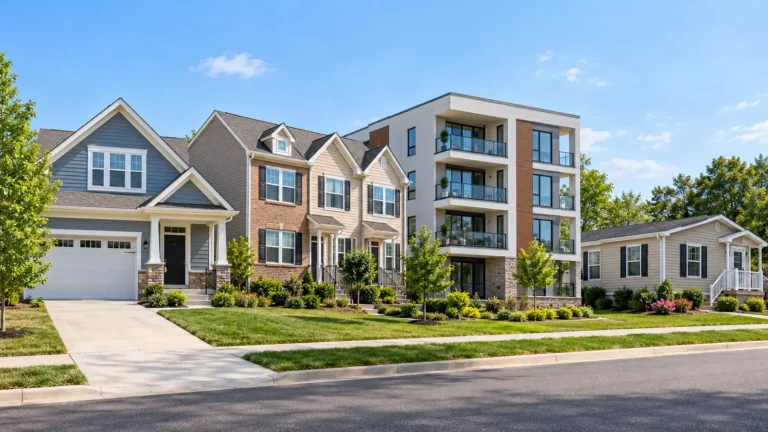
Condo vs Townhouse: Key Differences Buyers Should Know
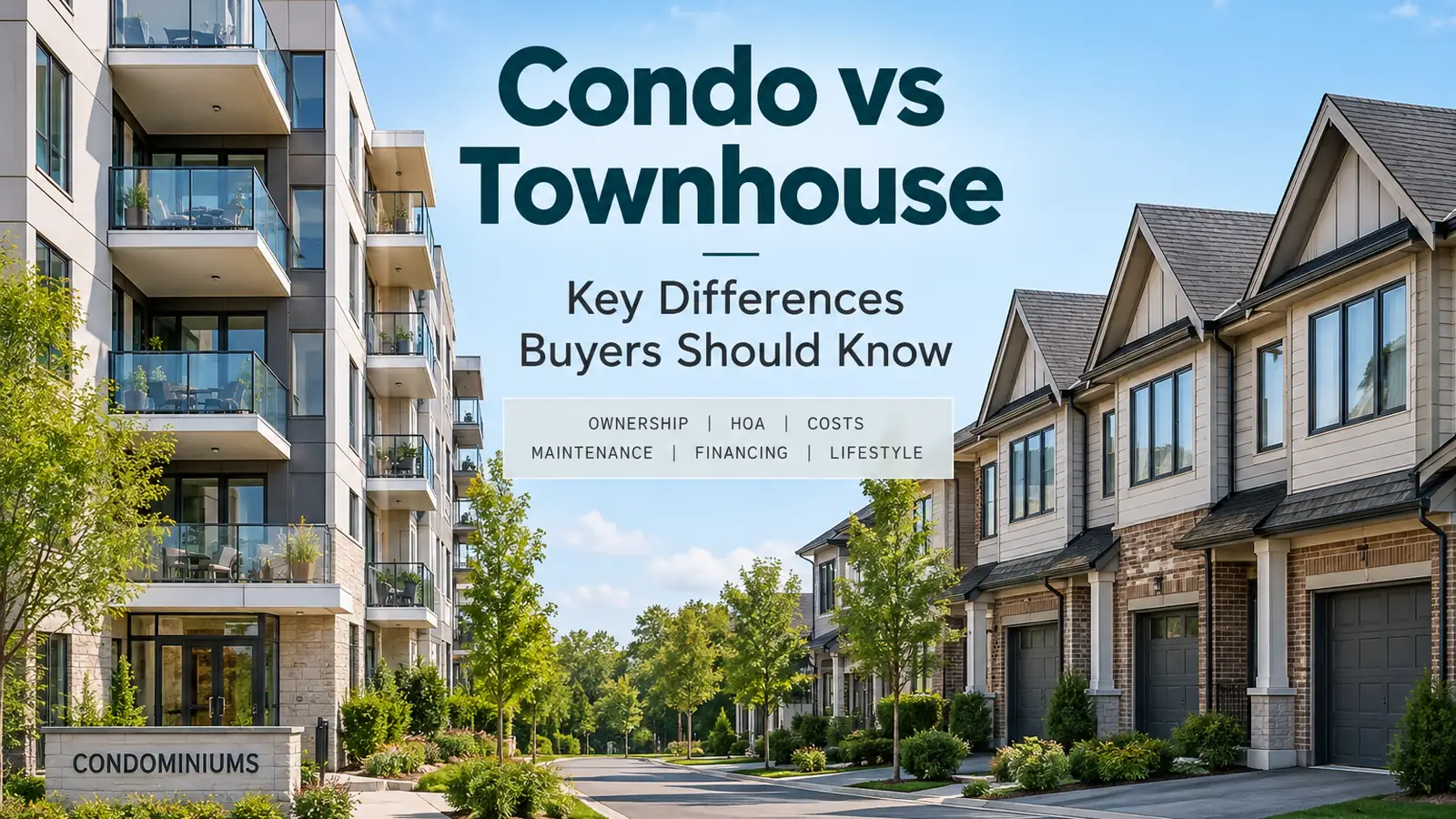
A condo vs townhouse comparison becomes much clearer once you separate what the property looks like from how it is legally owned.
A townhouse usually describes the physical form of a home: an attached residence that shares one or more walls with neighboring properties and commonly has its own entrance. A condominium, by contrast, primarily describes an ownership arrangement in which an owner holds an individual unit along with rights or interests in shared elements.
That means the two categories are not always opposites.
A townhouse-style home can itself be legally organized as a condominium. Another nearly identical townhouse may be owned differently, with the buyer holding title to the structure and land while an HOA maintains only certain community areas.
That distinction can change who is responsible for the roof, siding, landscaping, insurance, common areas, association dues, repairs, financing requirements, and even what you are allowed to renovate or rent.
So the most important question is not simply:
Is this a condo or a townhouse?
It is:
What exactly am I buying, what will I be responsible for, and what obligations come with the property?
This guide compares condos and townhouses from that buyer-first perspective.
Condo vs Townhouse: The Short Answer
The simplest distinction is:
Townhouse usually describes physical form. Condo usually describes legal ownership.
A townhouse commonly:
- shares one or more side walls;
- has a private entrance;
- has multiple floors;
- may include a garage, patio, or small yard; and
- often feels more like a traditional house than an apartment-style unit.
A condominium may be:
- an apartment-style unit;
- an attached townhouse;
- a detached dwelling; or
- another residential form organized under condominium ownership.
HUD’s FHA materials recognize condominium units that can include horizontally attached townhouse dwellings, which is one reason buyers should not assume that the appearance of a property determines its legal ownership. See the HUD condominium information.
The real comparison therefore depends on the specific properties.
A fee-simple townhouse and a townhouse-style condominium can look almost identical from the street while placing very different responsibilities on their owners.
Condo vs Townhouse at a Glance
These are common patterns, not universal rules.
| Factor | Condo | Townhouse |
|---|---|---|
| Basic meaning | Primarily an ownership arrangement | Primarily a physical housing form |
| What you own | Defined by condominium documents | Depends on the legal ownership structure |
| Shared walls | May or may not have them | Usually shares one or more side walls |
| Exterior maintenance | Often partly association-managed | Can be owner- or association-managed |
| Land | Depends on unit boundaries and documents | May be individually owned or part of another arrangement |
| Association | Typically part of a condominium association | HOA may exist, but structure and duties vary |
| Insurance | Owner coverage works with applicable master coverage | Individual or association coverage can vary |
| Financing | Project review may apply depending on loan/program | Depends partly on legal ownership structure |
| Privacy | Depends heavily on building form | Often no neighbors above or below |
| Control | Governing documents can limit changes | Can offer more exterior control, but not always |
The table is useful for orientation, but it should not replace document review.
Two properties marketed under different labels can sometimes be more alike than two properties marketed under the same label.
Why a Townhouse Can Also Be a Condo
This is the distinction many quick condo vs townhouse comparisons miss. Imagine two rows of attached homes.
Both properties have:
- two stories;
- private front doors;
- attached garages;
- small patios;
- shared side walls; and
- similar exterior architecture.
From the sidewalk, they look like the same property type. Legally, they may be very different.
Property A: Fee-Simple Townhouse
The buyer may own the dwelling and the lot beneath or around it, subject to applicable HOA rules. The owner might be responsible for:
- roof;
- siding;
- windows;
- exterior painting;
- yard;
- driveway; and
- other components.
The HOA might maintain only:
- community landscaping;
- private roads;
- entrance signs;
- shared recreational facilities; or
- other common amenities.
Property B: Townhouse-Style Condominium
The home has the same townhouse appearance, but it is legally part of a condominium. The condominium documents define:
- what constitutes the owner’s unit;
- what is a common element;
- what may be a limited common element;
- who maintains each component;
- what the association insures; and
- which costs are shared.
The association might be responsible for some exterior components that the owner of Property A must maintain personally.
Or the governing documents might allocate responsibilities differently. The point is not that one arrangement is inherently better. It is that appearance does not tell you enough.
This is why our broader guide to different types of homes separates physical structure from ownership arrangement and construction method.
Use a Four-Layer Buyer Verification Framework
Instead of relying on the listing label, evaluate a condo or townhouse through four layers.
Layer 1: Physical Form
Start with what you can see and experience. Ask:
- Are there shared side walls?
- Are there neighbors above or below?
- Is the entrance private?
- How many floors are inside the unit?
- Is there private outdoor space?
- Is parking attached, assigned, common, or street-based?
- Are major building systems shared?
- Are there elevators?
- How much separation exists from neighboring homes?
This layer tells you how the property may feel to live in. It does not tell you exactly what you own.
Layer 2: Legal Ownership
Now determine what the legal documents actually convey. Ask:
- What does the deed describe?
- What are the legal unit boundaries?
- Is land included in the individual ownership?
- What areas are common?
- Are any areas limited common elements?
- Is the property organized as a condominium?
- Is it part of an HOA or planned community?
- What rights accompany parking, storage, patios, decks, or yards?
This layer tells you what you are actually buying.
Layer 3: Responsibility Allocation
Determine who takes care of what. Ask who maintains or replaces:
- roof;
- siding;
- windows;
- doors;
- foundation;
- landscaping;
- driveway;
- walkways;
- fences;
- decks;
- balconies;
- drainage;
- plumbing lines;
- private roads;
- shared utilities;
- common structures; and
- amenities.
Do not infer these responsibilities from the words “condo” or “townhouse.” Read the governing documents.
Layer 4: Financial and Transaction Treatment
Finally, translate the structure into money and transaction risk.
Consider:
- association dues;
- known assessments;
- reserve funding;
- owner-paid maintenance;
- insurance obligations;
- property taxes;
- parking or amenity charges;
- lender requirements;
- condominium project review where applicable;
- rental restrictions; and
- future resale considerations.
This fourth layer turns a property-type label into an actual buying decision.
What Do You Actually Own?
Ownership is one of the most important differences to verify.
With a condominium, the governing declaration and legal description establish the boundaries of the individual unit and the owner’s relationship to common elements.
With a townhouse, the physical structure alone does not answer the ownership question.
Depending on the development, a townhouse buyer might own:
- the dwelling;
- the land beneath it;
- a defined lot;
- certain exterior features; or
- a condominium unit within a townhouse-style structure.
That distinction can affect control and responsibility. For example, suppose you want to:
- replace exterior windows;
- build a fence;
- change the front door;
- install solar panels;
- alter landscaping;
- enlarge a patio; or
- replace the roof.
Whether you can make that change yourself may depend on both ownership boundaries and association rules.
Do Not Rely on the Listing Description
Terms used in listings can be helpful for browsing, but they are not substitutes for legal documents. Before making an offer, ask for or confirm the documents that establish:
- ownership;
- unit or lot boundaries;
- common elements;
- association rights; and
- maintenance responsibilities.
If the answer affects a significant legal or financial decision and the documents are unclear, consider getting appropriate professional guidance rather than guessing.
HOA and Association Responsibilities
Both condos and townhouses may involve associations, but the mere existence of an association tells you very little about what it actually does. One community’s dues might primarily support:
- landscaping;
- entrance maintenance; and
- a small common area.
Another association might manage:
- roofs;
- building exteriors;
- private roads;
- insurance on certain structures;
- pools;
- elevators;
- security;
- clubhouses;
- snow removal;
- water;
- sewer;
- trash; and
- extensive common landscaping.
Those are very different financial arrangements.
Compare What the Fee Buys
Do not compare two properties only by asking which has the lower monthly association fee. Instead ask:
What expenses does each fee replace or share?
A higher association fee may cover responsibilities you would otherwise pay for directly. A lower fee may leave more repair and maintenance costs with the individual owner.
The Consumer Financial Protection Bureau notes that condo, co-op, and HOA dues are generally paid separately from the mortgage payment and should be included when assessing housing affordability. See the CFPB guidance on condo and HOA dues.
Review the Financial Health of the Association
Monthly dues are only one part of the picture. Also investigate, where applicable:
- budget;
- reserve funds;
- planned capital projects;
- recent assessments;
- pending assessments;
- delinquent assessments;
- major deferred maintenance;
- insurance costs;
- litigation; and
- upcoming repair obligations.
A low monthly fee is not automatically good news if the association is postponing major work or lacks adequate resources for predictable repairs.
Likewise, a higher fee is not automatically a problem if it supports substantial services, reserves, maintenance, or amenities that matter to you.
Maintenance: Who Handles the Roof, Exterior and Grounds?
Maintenance is one of the most common reasons buyers choose between a condo and a townhouse. It is also one of the easiest areas to oversimplify. A common assumption is:
Condo owner = interior only. Townhouse owner = everything inside and outside.
That assumption may describe some properties. It is not a universal rule.
For a Condo
The association may maintain some combination of:
- roof;
- siding;
- exterior paint;
- hallways;
- elevators;
- landscaping;
- common plumbing;
- common electrical systems;
- private roads;
- shared recreational facilities; and
- structural components.
The individual owner may remain responsible for components within the unit and possibly certain limited common elements. Exact boundaries depend on the declaration and other governing documents.
For a Townhouse
Responsibility can vary widely. In one fee-simple townhouse community, the owner may personally maintain:
- roof;
- siding;
- windows;
- driveway;
- yard; and
- exterior structures.
In another development, the HOA may maintain some of those components. And if the townhouse is legally a condominium, its allocation can resemble other condominium ownership arrangements.
Maintenance Tolerance Matters
Ask yourself whether you want more direct control or more shared management. Direct responsibility can give you greater control over when and how work is completed.
Shared responsibility can reduce the number of exterior projects you personally coordinate, but you give up some individual control and share financial exposure with the rest of the community. Neither model is automatically superior.
Condo vs Townhouse Costs: Compare the Total Ownership Picture
Purchase price alone is a poor way to choose between two properties. The more useful comparison is the total ownership picture.
For each property, estimate or verify;
- property taxes
- mortgage payment
- homeowners or unit-owner insurance
- association dues
- known assessments
- owner-paid maintenance
- parking or amenity charges
- utilities not included elsewhere
All these will result to practical recurring ownership cost. This is not a universal financial formula, and some costs are irregular rather than monthly. It is a comparison framework.
Example
Suppose Property A has lower HOA dues than Property B. That sounds favorable until you discover:
Property A
- owner replaces the roof;
- owner maintains siding and exterior paint;
- owner handles landscaping;
- owner maintains the driveway.
Property B
- association maintains the roof;
- association handles exterior painting;
- association maintains common grounds;
- some building insurance is carried through a master policy.
Property B’s higher dues may still be reasonable when you compare what those dues cover. The opposite can also happen.
A high association fee can be burdensome if it funds services or amenities you do not value. The right comparison is to ask “what am I paying, what does that payment cover, what remains my responsibility, and what future costs could reasonably arise?”
Watch for Special Assessments
Associations sometimes need additional owner contributions for major costs that are not fully covered by normal dues or available reserves. Before buying, ask whether there are:
- current assessments;
- approved future assessments;
- major projects under discussion; or
- substantial deferred repairs.
A known assessment should be part of your financial evaluation, not something discovered after closing.
Insurance Differences
Insurance should be evaluated from the legal ownership and association structure rather than from appearance.
For a condominium, the association typically carries some form of master coverage for property or common interests as required by the governing structure and applicable rules.
The individual owner generally needs coverage appropriate to the unit owner’s responsibilities. The exact dividing line matters.
For example, you need to know how the master policy treats:
- building structure;
- common elements;
- interior finishes;
- fixtures;
- improvements;
- personal property; and
- liability.
The National Association of Insurance Commissioners explains that condominium unit-owner coverage is designed differently from a standard homeowners policy and also notes that a townhouse may be insured through either an individual homeowners policy or an association master policy. See the NAIC Consumer’s Guide to Home Insurance.
Ask for the Master-Policy Information
If an association carries master insurance, do not assume it covers everything you need. You need to ask:
- What does the master policy cover?
- What is the deductible?
- Could an owner be responsible for part of a deductible?
- Which parts of the unit need individual coverage?
- Are improvements or betterments covered?
- What personal liability coverage is needed?
- Are there coverage requirements imposed by the association or lender?
Then discuss the actual property with an insurance professional before relying on an estimated premium.
Two townhouse-style homes can require very different insurance arrangements if one is fee-simple and the other is condominium-owned.
Financing Differences
Financing is another area where legal structure matters more than appearance. For a typical mortgage, the lender evaluates the borrower and the property.
With a condominium purchase, there may also be a project-level eligibility or review layer depending on the loan program, project, and transaction.
Fannie Mae maintains specific condo, co-op and PUD eligibility guidance, including condominium project-review processes.
Freddie Mac likewise maintains condominium unit mortgage and project-review requirements.
This does not mean condos are always harder to finance. It means that the project’s characteristics can become part of the lender’s analysis in addition to your personal qualification.
Depending on the transaction, project factors can include matters such as:
- project condition;
- insurance;
- financial viability;
- commercial use;
- ownership structure;
- assessments;
- project status; and
- other eligibility requirements.
What About a Townhouse?
A fee-simple townhouse may be treated differently from a townhouse-style condominium because the legal ownership structure is different.
That is why you should tell the lender what the property legally is rather than relying only on the listing’s architectural label.
If you want to understand borrower qualification, preapproval, underwriting, loan estimates, and closing more broadly, see our guide to how to get a mortgage.
Privacy, Space, Stairs, Parking and Amenities
Legal ownership is critical, but you still have to live in the home. Daily experience can differ substantially between properties.
Privacy
A townhouse commonly shares side walls but may have no neighbors directly above or below. An apartment-style condo may have units above, below, beside or across a shared hallway. But a townhouse-style condo could provide the same side-wall arrangement as another townhouse.
Visit the actual property and pay attention to:
- sound transfer;
- window placement;
- entrances;
- patios;
- balconies;
- shared hallways; and
- outdoor areas.
Space and Layout
Townhouses often use vertical layouts. That can provide substantial living space on a smaller footprint, but it can also mean frequent stair use.
Think about:
- bedroom locations;
- laundry location;
- groceries;
- mobility;
- young children;
- aging in place;
- home-office needs; and
- moving furniture.
An elevator condo may be more convenient for some buyers. A ground-level condo may work better for another.
A multistory townhouse may appeal to someone who wants greater separation between living and sleeping areas.
Parking
Verify whether parking is:
- deeded;
- assigned;
- common;
- garage-based;
- driveway-based;
- permit-controlled; or
- street-only.
Also ask about:
- guest parking;
- commercial vehicles;
- EV charging;
- storage;
- snow removal; and
- parking enforcement.
Amenities
Condominium and townhouse communities can both offer amenities such as:
- pool;
- gym;
- clubhouse;
- playground;
- security;
- walking trails;
- landscaping;
- recreational areas; and
- community events.
Amenities can be valuable if you will actually use them. If you will not, they may simply become another shared expense.
Rules, Renovations, Pets and Rental Restrictions
Shared communities usually involve rules. Do not wait until after closing to discover that the property limits something important to you.
Review restrictions affecting:
- pets;
- pet size or number;
- parking;
- exterior appearance;
- fences;
- satellite equipment;
- solar installations;
- short-term rentals;
- long-term rentals;
- leasing waiting periods;
- occupancy;
- business use;
- flooring;
- noise;
- holiday decorations;
- patios;
- balconies; and
- renovations.
Renovation Control Can Differ
Even when you own a townhouse lot, an HOA may restrict exterior changes.
In a condominium, changes affecting common elements, structural components, exterior appearance, plumbing, electrical systems, or other shared components may require association approval.
If you have a renovation plan in mind, investigate it before making the purchase decision. Do not assume you own it, therefore you can change it.
Ownership rights can be subject to declarations, covenants, bylaws, rules, permits, zoning, and other restrictions.
Resale and Future Flexibility
There is no reliable universal rule that condos appreciate more slowly or townhouses appreciate faster. Real estate performance depends on far more than the category label. Resale can be influenced by:
- location;
- local supply and demand;
- property condition;
- association condition;
- dues;
- assessments;
- insurance availability;
- amenities;
- restrictions;
- parking;
- layout;
- project reputation;
- financing eligibility; and
- the condition of competing properties.
Think About the Next Buyer
Ask what future buyers may evaluate. For a condo, that can include both the unit and the condominium project. For a townhouse, buyers may evaluate:
- exterior condition;
- land or yard responsibility;
- HOA obligations;
- shared walls;
- parking; and
- maintenance history.
Flexibility Matters Too
Your plans may change. Consider whether the property fits possible future needs involving:
- remote work;
- children;
- pets;
- aging in place;
- relocation;
- renting the property;
- remodeling;
- additional vehicles; or
- long-term maintenance.
Rules that seem irrelevant today can become important later.
A Hypothetical Look-Alike Example
Consider two hypothetical attached homes in neighboring developments. They both sell for similar prices. Both have:
- three bedrooms;
- two and a half bathrooms;
- two floors;
- one-car garages;
- small patios;
- shared side walls; and
- HOA or association dues.
At first glance, choosing between them appears to be a matter of layout and price.
Home A
Home A is a fee-simple townhouse. Its documents place responsibility for the following on the owner:
- roof;
- siding;
- exterior paint;
- windows;
- driveway;
- patio; and
- small yard.
Its HOA maintains:
- entrance landscaping;
- private community road;
- playground; and
- shared green space.
Home B
Home B is a townhouse-style condominium. Its declaration places specified exterior elements and common property under association responsibility.
The owner’s unit boundaries and individual obligations are defined in the condominium documents. Its association dues are higher than Home A’s.
Which One Is Cheaper?
You cannot answer that from dues alone. Home A has lower shared costs but more direct maintenance exposure. Home B has higher dues but shifts some responsibilities into the association structure. You would need to compare:
- purchase price;
- association dues;
- insurance;
- taxes;
- reserve position;
- assessments;
- owner-paid maintenance;
- what each association covers; and
- your tolerance for future repair responsibility.
Which One Gives You More Control?
Again, do not guess. Home A may provide more direct exterior responsibility but still impose HOA architectural rules. Home B may place more exterior control with the association.
The legal documents, not the architectural appearance, answer the question.
This hypothetical example is why a useful condo vs townhouse comparison should start with ownership and responsibilities rather than a generic pros-and-cons list.
What to Verify Before You Make an Offer
Use this document-first matrix when comparing actual properties.
| Question | Where to verify | Why it matters |
|---|---|---|
| What do I legally own? | Deed/title documents | Establishes the legal interest being purchased |
| What are the unit or lot boundaries? | Declaration, plat or survey | Shows where individual ownership begins and ends |
| Who maintains the exterior? | Declaration, CC&Rs, maintenance chart | Determines repair responsibility |
| Who handles the roof? | Governing documents | A major cost should never be assumed |
| What does the association maintain? | Budget, governing documents | Helps explain what dues actually fund |
| Are assessments pending? | Association records, budget, notices | Can affect near-term ownership cost |
| How healthy are reserves? | Budget, reserve information | Helps evaluate shared-property financial exposure |
| What does master insurance cover? | Master policy or coverage summary | Helps identify individual insurance needs |
| Are rentals restricted? | Declaration, bylaws, rules | Can affect future flexibility |
| Are pets restricted? | Rules and regulations | Important before committing to the property |
| Are renovations restricted? | CC&Rs, declaration, architectural rules | Determines what changes need approval |
| Does condo project review apply? | Lender / applicable loan requirements | Can affect financing and transaction timing |
Not every document uses the same name in every state or development.
The objective is to locate the source that actually controls the issue rather than relying on a salesperson’s summary or a listing description.
Condo vs Townhouse: Which Is Better for You?
There is no universal winner. The better property is the one whose actual legal structure, responsibilities, cost, rules, and living experience fit you.
A Condo May Fit Better When:
- you value a location where condo inventory is common;
- the actual association handles exterior or common-property responsibilities you prefer not to manage personally;
- you want shared amenities;
- the layout fits your accessibility or lifestyle needs;
- you understand and accept the dues;
- the association’s rules work for you; and
- the project and financing structure fit your transaction.
The key word is actual. Do not choose a condo merely because you assume it means “maintenance-free.”
A Fee-Simple Townhouse May Fit Better When:
- you prefer a private entrance and house-like layout;
- you do not want neighbors above or below;
- you value some private outdoor space;
- the ownership includes the land or exterior control you want;
- you are comfortable with the maintenance responsibilities allocated to you;
- the HOA’s scope and rules are acceptable; and
- the total cost fits your budget.
Again, verify the specific property. A townhouse with extensive HOA responsibilities may behave differently from a townhouse where the owner maintains nearly everything.
A Townhouse-Style Condo May Fit Better When:
You like the physical benefits of a townhouse but prefer the particular condominium’s allocation of shared responsibilities.
This is exactly why “condo or townhouse?” can be the wrong first question. A better sequence is:
- What does the property physically look like?
- What do I legally own?
- Who is responsible for what?
- What will that structure cost me and require from me?
Once those four answers are clear, the decision becomes much easier.
Questions Buyers Ask About Condos and Townhouses
Can a Townhouse Be a Condo?
Yes. A townhouse describes a common physical housing form, while condominium describes an ownership arrangement. A townhouse-style dwelling can therefore be legally organized as a condominium.
Do Townhouses Always Have HOAs?
No. Many townhouse developments have HOAs, but you should not assume every townhouse does.
Where an HOA exists, its responsibilities can range from relatively limited common-area functions to much broader maintenance and governance.
Does a Townhouse Always Include the Land?
No. Land ownership depends on the property’s legal structure and documents.
Some townhouse owners hold title to an individual lot. Other townhouse-style properties are condominiums with boundaries defined by the condominium declaration.
Verify the deed, declaration, plat, or other applicable documents.
Are Condo Fees Always Higher Than Townhouse HOA Fees?
No. Association fees vary according to the specific community, services, amenities, insurance, maintenance responsibilities, reserves, and other costs.
A useful comparison asks what each fee covers rather than assuming one category is universally more expensive.
Is a Condo Harder to Finance?
Not necessarily. A condominium mortgage can involve project-level eligibility or review requirements in addition to borrower underwriting, depending on the loan program and transaction.
That does not mean every condo is difficult to finance. Discuss the specific project and loan with your lender early.
Who Insures the Roof and Exterior?
It depends on the ownership structure, governing documents, and insurance arrangement.
The association may insure or maintain certain components in some communities, while the individual owner is responsible in others.
Review the master policy and governing documents and confirm your individual coverage needs.
Which Requires Less Maintenance?
Neither category automatically wins. A condo association may manage more exterior or common-property maintenance, but the owner funds shared costs through dues and potentially assessments.
A fee-simple townhouse may place more maintenance directly on the homeowner. A townhouse-style condominium may operate differently again. Compare the actual responsibility allocation.
Before You Choose Between a Condo and Townhouse
A useful condo vs townhouse decision is not about choosing the label you prefer. It is about understanding the property behind the label.
Before making an offer, confirm:
- the physical form of the home;
- the legal ownership structure;
- what land, if any, is individually owned;
- the unit or lot boundaries;
- shared walls and building systems;
- exterior maintenance responsibilities;
- roof responsibility;
- landscaping responsibility;
- association dues;
- what those dues cover;
- current or planned assessments;
- reserve and maintenance information;
- master insurance coverage;
- your individual insurance needs;
- lender or project-review requirements;
- parking and storage rights;
- renovation restrictions;
- pet rules;
- rental restrictions;
- amenities;
- privacy;
- stairs and accessibility; and
- the practical total cost of ownership.
Two attached homes can look nearly identical and create very different ownership experiences.
That is why the strongest buying decision comes from moving beyond the listing label and verifying what you own, who handles what, what you pay for, and which rules follow the property.
Once you have compared those factors and chosen the type of ownership that fits your needs, use our step-by-step guide to how to buy a house to move through budgeting, financing, property search, offers, inspections, closing, and homeownership.