Types of Homes: A Buyer’s Guide to Common Property Types
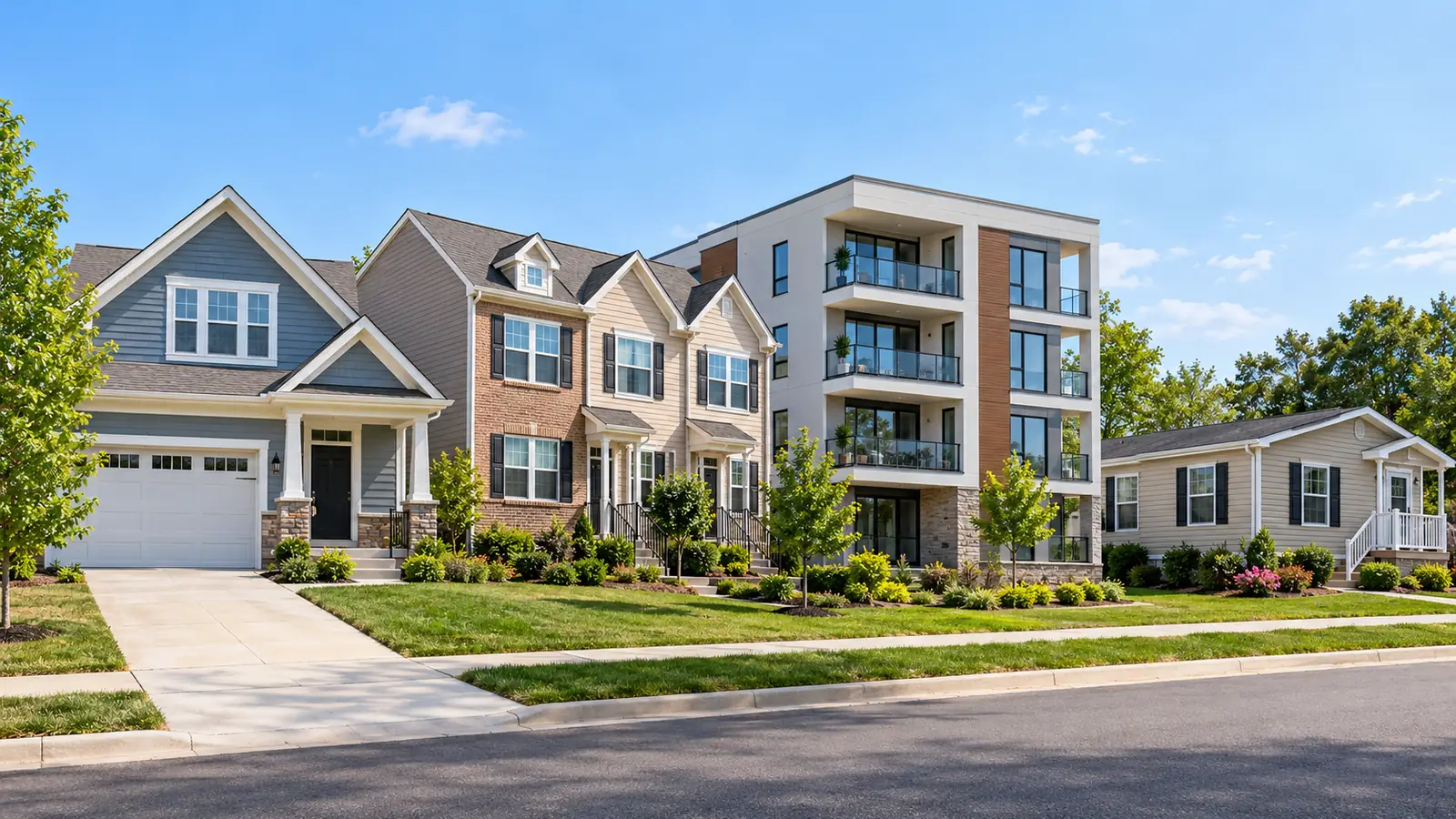
Types of homes can look similar from the curb while creating very different ownership, maintenance, financing, privacy, and lifestyle responsibilities for the buyer.
A detached house, townhouse, condominium, cooperative, duplex, manufactured home, and modular home are not simply different versions of the same thing. Some terms describe the physical structure. Others describe how ownership works. Some describe how the home was built.
That distinction matters because the home you choose affects more than appearance. It can influence whether you own land, share walls, pay association fees, maintain the exterior yourself, share common areas, qualify under particular lending requirements, or take on responsibilities for additional housing units.
The U.S. Census Bureau itself classifies housing structures using categories such as one-unit detached, one-unit attached, two-unit buildings, larger multi-unit structures, and manufactured/mobile housing. That is one useful way to think about residential structure, but buyers also need to understand ownership arrangements and construction methods. U.S. Census Bureau housing-structure data
The goal of this guide is not to create the longest possible list of house names. It is to help you understand the common property types buyers encounter in the United States and what each one may mean for your budget, control, maintenance workload, privacy, and long-term plans.
What Does “Type of Home” Actually Mean?
The phrase “type of home” is used loosely in real estate.
That is why lists of different types of homes sometimes mix together townhouses, condominiums, ranch houses, manufactured homes, duplexes, and Colonials as though all of those terms describe the same characteristic.
They do not. A clearer way to classify a property is to separate four questions.
What is the physical structure?
This describes how the building is arranged.
Examples include:
- detached single-family home;
- attached single-family home;
- townhouse;
- duplex;
- triplex;
- fourplex; and
- larger multifamily building.
A detached home has open space separating it from other homes. An attached home shares one or more walls.
What is the ownership arrangement?
This describes what the buyer legally owns and what may be jointly controlled.
Examples include:
- fee-simple ownership;
- condominium ownership;
- cooperative ownership; and
- ownership within a planned community or association.
This distinction is important because physical appearance does not always determine legal ownership.
For example, HUD’s FHA materials recognize that condominium ownership can apply not only to units in large buildings but also to certain detached homes and townhouse-style dwellings. In other words, “condo” is fundamentally an ownership structure, not a description of what the building must look like. HUD condominium information
How was the home constructed?
Construction method is another separate category.
A house may be:
- site-built;
- modular;
- manufactured; or
- built using another prefabricated or panelized system.
A modular home, for example, may look like a conventional detached house after completion. Its construction method does not automatically tell you its architectural style or ownership arrangement.
What architectural style does it have?
Architectural style generally describes design.
Examples include:
- Ranch;
- Colonial;
- Craftsman;
- Cape Cod;
- Tudor;
- Victorian; and
- contemporary styles.
A Colonial may be a detached single-family home. A townhouse development may use a Colonial-inspired design. A modular home may be designed in a Craftsman style.
One property can therefore fit several descriptions at the same time.
You might be looking at an attached townhouse in physical form, condominium ownership legally, modular construction method, and contemporary architectural design.
Understanding those layers makes the rest of the home-buying comparison much more useful.
Types of Homes at a Glance
The table below focuses on the categories most relevant to buyers rather than architectural styles.
| Home type | Key difference | Buyer tradeoff |
|---|---|---|
| Single-family detached | No shared walls | More privacy; more maintenance |
| Townhouse / attached | Shares walls with neighbors | Less separation; ownership can vary |
| Condominium | Unit plus common elements | Shared upkeep; fees and rules may apply |
| Co-op | Shares tied to occupancy rights | Different approval and financing considerations |
| Small multifamily | Two to four residential units | Income potential; more management |
| Manufactured home | Built to federal HUD standards | Land, title, and financing matter |
| Modular home | Built to state/local codes | Site and code requirements still apply |
No row in this table tells you automatically whether a particular home is affordable, easier to finance, or appropriate for your household.
Those questions depend on the actual property, location, legal documents, association, lender, insurance availability, condition, taxes, land arrangement, and your financial situation.
Single-Family Detached Homes
A single-family detached home is what many buyers picture when they hear the word “house.”
The building stands separately from neighboring homes rather than sharing a wall.
The Census Bureau defines a one-unit detached structure as a one-unit building with open space on all four sides, even when it has an adjoining garage or shed.
Why buyers choose detached homes
Common advantages can include:
- greater physical separation from neighbors;
- private outdoor space;
- more control over exterior changes;
- room for additions or accessory features where permitted;
- storage;
- parking;
- fewer shared building systems; and
- less noise transfer through party walls.
Detached ownership can also make responsibilities easier to understand because one household is often responsible for the structure and lot.
But “detached” does not mean “no rules.”
A detached home can still be located in:
- an HOA community;
- a planned development;
- a condominium regime;
- a historic district; or
- another area with restrictions.
Always review the actual ownership documents rather than assuming the physical structure tells you everything.
The maintenance tradeoff
More control often means more responsibility.
A detached homeowner may be responsible for:
- roof;
- siding;
- foundation;
- driveway;
- yard;
- landscaping;
- drainage;
- exterior painting;
- fencing;
- heating and cooling systems;
- plumbing; and
- other property systems.
That workload can be a benefit for someone who wants control, but a disadvantage for a buyer who prefers shared maintenance.
Townhouses and Attached Single-Family Homes
A townhouse is usually a multi-level home that shares one or more walls with neighboring dwellings.
Townhouses can offer a middle ground between detached houses and apartment-style living.
They may provide:
- a private entrance;
- more living space than some condos;
- multiple floors;
- a garage or driveway;
- a small yard or patio; and
- a neighborhood with shared amenities.
But the term “townhouse” by itself does not tell you exactly what you own.
A townhouse is a structure, not one universal ownership model
One townhouse buyer may own the building and the land beneath it.
Another may own the unit under a condominium form of ownership.
Another may be part of a planned development with separate HOA responsibilities.
That difference can affect:
- exterior maintenance;
- roof responsibility;
- insurance;
- association dues;
- common areas;
- landscaping;
- approval requirements; and
- financing.
Before buying, determine what the governing documents say rather than relying on the listing label alone.
Shared walls change the living experience
Attached homes can use land efficiently and may be available in locations where detached homes are more expensive or scarce.
The tradeoff is proximity.
Consider:
- noise transfer;
- shared-wall maintenance;
- parking;
- visitor parking;
- outdoor space;
- stairs;
- association rules; and
- how close neighboring entrances and patios are to yours.
A townhouse may feel almost like a detached house in one development and much closer to condominium living in another.
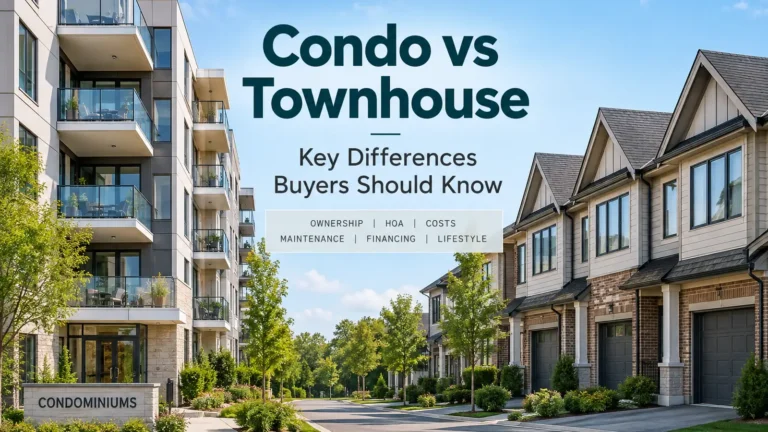
If you are deciding between these two options, our condo vs townhouse comparison explains how ownership, HOA responsibilities, maintenance, insurance, financing, costs, and privacy can differ.
Condominiums
A condominium is primarily a legal form of property ownership.
The buyer typically owns an individual unit and also holds an interest in common elements shared with other owners.
Common elements can include:
- hallways;
- elevators;
- roofs;
- exterior walls;
- grounds;
- pools;
- clubhouses;
- parking structures;
- roads;
- utility infrastructure; and
- other shared property.
Exactly what is individually owned versus common depends on the condominium declaration and other governing documents.
Why condos appeal to buyers
Condominium ownership can be attractive when a buyer wants:
- less individual exterior maintenance;
- access to shared amenities;
- a lower-maintenance lifestyle;
- urban or high-density locations;
- security features;
- professional management; or
- a smaller property footprint.
But reduced direct maintenance does not mean maintenance becomes free.
Association expenses are generally funded through owner dues, and owners may also face special assessments when major costs exceed available reserves.
The Consumer Financial Protection Bureau notes that condo, co-op, and HOA fees are usually paid separately from the mortgage payment and should be included when judging affordability. CFPB guidance on condo, co-op and HOA dues
Review more than the unit
When buying a condo, you are evaluating both the home and the larger project.
Documents worth reviewing can include:
- declaration;
- bylaws;
- budget;
- reserve information;
- insurance information;
- rules;
- recent meeting records where available;
- pending litigation;
- special assessments;
- rental restrictions; and
- maintenance responsibilities.
A beautifully renovated unit can still be a poor fit if the association’s finances, rules, or maintenance obligations do not work for you.
Financing can involve the project as well as the borrower
A lender evaluating a condominium purchase may need information about the condominium project in addition to the buyer’s finances.
That does not mean condos are automatically difficult to finance. It means the ownership structure can introduce project-level review that would not necessarily exist with a typical detached home.
If you are preparing for financing generally, our guide to how to get a mortgage covers the broader mortgage process.
Cooperative Housing
Cooperative housing, commonly called a co-op, uses a different ownership model.
Instead of purchasing conventional title to an individual real-estate unit, a buyer generally purchases shares or membership rights in the cooperative organization, along with the right to occupy a particular unit.
HUD describes cooperative members as sharing ownership of the project while receiving the exclusive right to occupy a specific unit through stock ownership. HUD cooperative housing description
Why that distinction matters
A co-op purchase may involve:
- cooperative board requirements;
- financial review;
- occupancy rules;
- monthly maintenance charges;
- building-level debt or obligations;
- restrictions on renting;
- transfer requirements; and
- financing arrangements that differ from conventional real-estate ownership.
Co-ops are much more common in some U.S. markets than others.
Do not assume the rules in one city, state, or building apply to cooperative housing everywhere.
Evaluate the organization as well as the unit
A buyer should understand:
- what the shares provide;
- what monthly charges cover;
- the cooperative’s financial position;
- building maintenance;
- approval requirements;
- occupancy restrictions;
- subletting rules;
- underlying financing; and
- resale procedures.
A co-op can provide a desirable home and strong community structure, but the buyer is entering a shared legal and financial organization rather than purchasing only an isolated physical unit.
Multifamily Homes
A multifamily property contains more than one housing unit.
For many ordinary homebuyers, the most relevant small multifamily properties are:
- duplexes;
- triplexes; and
- fourplexes.
These can allow an owner to live in one unit while renting another.
Why buyers consider small multifamily properties
Possible benefits include:
- rental income;
- partial offset of housing costs;
- housing for extended family;
- separation between living spaces;
- flexibility as household needs change; and
- potential long-term investment value.
But income potential comes with additional responsibilities.
You may need to manage:
- tenants;
- leases;
- maintenance requests;
- vacancies;
- utilities;
- insurance;
- local landlord requirements;
- repairs affecting multiple units; and
- privacy between occupants.
A duplex is not simply a large single-family home with an extra kitchen. Its legal use, zoning, financing, insurance, and rental operation can require additional attention.
Make sure the property is legally what it appears to be
A listing may advertise a second unit, basement apartment, converted garage, or accessory space.
That does not automatically mean the space is legally recognized as an independent dwelling unit.
Before relying on expected rental income or separate occupancy, verify applicable:
- permits;
- zoning;
- certificates or occupancy requirements;
- utility arrangements; and
- local rental rules.
Manufactured Homes
Manufactured homes are factory-built housing constructed under the federal Manufactured Home Construction and Safety Standards administered by HUD.
HUD currently describes a manufactured home as a factory-built dwelling constructed to the HUD Code and transported in one or more sections on a permanent chassis. Homes built under the federal standards carry certification labels on their transportable sections. HUD manufactured housing homeowner resources
Manufactured housing is not just another name for a modular home
The terms are often used interchangeably in casual conversation, but the regulatory systems are different.
Manufactured homes are built to federal manufactured-housing standards.
Modular homes are generally constructed to the building codes applicable to the location where the home will be installed.
That distinction can affect:
- certification;
- installation;
- title;
- land arrangement;
- appraisal;
- insurance;
- financing; and
- local requirements.
The home and the land may be separate decisions
A manufactured-home buyer should determine whether the transaction includes:
- the dwelling;
- the land;
- both;
- or a home placed on leased land.
That distinction can materially change the economics of the purchase.
Questions to ask include:
- Who owns the land?
- Is there a lot lease?
- Can lot rent increase?
- Is the home titled as real property or personal property?
- What installation documentation exists?
- What foundation system is used?
- What insurance is available?
- What loan products apply?
- Are there community rules?
- What costs apply if the home ever needs to be relocated?
The word “manufactured” does not answer those questions by itself.
Modular Homes
A modular home is also built partly or substantially in a factory, but it is not the same regulatory category as a manufactured home.
HUD’s housing-counselor materials describe modular homes as factory-built to applicable state and local building codes, similar to site-built homes, before the completed modules are transported to the home site. HUD Housing Counselors glossary
Modular describes construction, not appearance
A completed modular home may look indistinguishable from a conventionally site-built home.
It can be:
- one story;
- two stories;
- traditional;
- contemporary;
- detached;
- attached; or
- designed in many architectural styles.
That is why modular belongs under construction method rather than a simple “house style” list.
Site conditions still matter
Factory construction does not eliminate site work.
A modular project can still require:
- land;
- foundation preparation;
- permits;
- utility connections;
- transportation;
- cranes or setting equipment;
- local inspections;
- grading;
- drainage; and
- final on-site work.
If you are specifically evaluating newly built property rather than comparing home types, our guide to buying a new construction home covers the broader builder, contract, inspection, financing, and closing issues involved in that process.
What About Apartments, Tiny Homes and ADUs?
Some familiar housing terms do not fit neatly into one national property-type category.
Apartments
“Apartment” commonly describes a residential unit within a larger building.
But the word alone does not tell you the ownership structure.
An apartment-style unit might be:
- rented from a landlord;
- individually owned as a condominium;
- occupied through a cooperative arrangement; or
- part of another multifamily ownership structure.
For a buyer, the legal ownership documents matter more than the everyday label.
Tiny homes
“Tiny home” mainly describes size and lifestyle rather than one uniform national legal category.
A tiny home could potentially be:
- site-built;
- modular;
- manufactured;
- built on a movable chassis; or
- governed by another local classification.
The rules can depend heavily on state and local:
- building codes;
- zoning;
- minimum-size requirements;
- foundation rules;
- utility requirements; and
- land-use regulations.
A buyer should determine how the specific property is legally classified rather than assuming every small house follows the same rules.
Accessory dwelling units
An accessory dwelling unit, or ADU, is generally a secondary residential space associated with a primary property.
Examples can include:
- backyard cottages;
- garage apartments;
- basement units; and
- attached secondary suites.
An ADU can add flexibility or rental potential, but it is not automatically a separately purchasable home.
Ownership, subdivision, renting, permitting, and occupancy rules depend on the jurisdiction and property.
Home Type vs. Architectural Style
Architectural style deserves attention when choosing a home, but it answers a different question.
Style describes design features.
Examples include:
- Ranch;
- Colonial;
- Craftsman;
- Tudor;
- Victorian;
- Cape Cod; and
- contemporary designs.
Property type tells you more about the structure or ownership arrangement.
A Ranch home could be:
- detached;
- condominium-owned;
- modularly constructed; or
- located in an HOA.
A Colonial could be an older site-built home or a newly constructed house.
A Craftsman-inspired property might be a detached home, townhouse, or part of a planned development.
Do not choose a property solely by architectural label without understanding what you actually own and what responsibilities come with it.
How Different Types of Homes Affect the Buying Decision
The right category is not simply the one with the lowest listing price or most attractive exterior.
Different types of homes redistribute cost and responsibility in different ways.
Purchase price is only one part of affordability
Compare the full housing cost.
Depending on the property, that may include:
- mortgage payment;
- property taxes;
- homeowners insurance;
- mortgage insurance where applicable;
- HOA or condominium dues;
- cooperative maintenance charges;
- lot rent;
- utilities;
- exterior maintenance;
- landscaping;
- reserves for repairs; and
- special assessments.
A condo with a lower purchase price may have significant monthly association dues.
A detached house with no association fee may require the owner to budget independently for the roof, exterior, yard, driveway, plumbing, and other systems.
The relevant question is not only, “What is the price?”
It is, “What will this property require me to pay for and maintain over time?”
Think about privacy and shared walls
Privacy needs vary.
A detached house generally provides greater physical separation.
A townhouse can offer private living space while sharing walls.
A condo in a larger building may involve neighbors above, below, and beside you.
A multifamily owner-occupant may have tenants or relatives living within the same structure.
Visit the property at different times if possible and consider:
- sound;
- parking;
- hallways;
- elevators;
- entrances;
- outdoor space;
- window placement; and
- proximity to neighbors.
Understand who maintains what
Never assume. Ask who is responsible for:
- roof;
- siding;
- windows;
- doors;
- landscaping;
- snow removal;
- driveways;
- decks;
- balconies;
- plumbing lines;
- exterior insurance;
- shared utilities;
- structural repairs; and
- common amenities.
The answer can change even between properties that look almost identical.
Evaluate association rules and shared costs
Condominiums, cooperative buildings, townhome communities, planned developments, and some detached-home neighborhoods may involve an association or governing organization.
Review:
- dues;
- budget;
- reserve funding;
- maintenance responsibilities;
- special assessments;
- rental restrictions;
- parking rules;
- pet rules;
- architectural controls; and
- approval requirements.
A well-managed association can take care of important shared responsibilities.
Poorly funded or poorly governed common property can create financial and practical problems for owners.
Confirm land ownership
Land is especially important when comparing:
- detached homes;
- townhouses;
- manufactured homes;
- communities with leased lots; and
- condominium arrangements.
Determine:
- whether land is included;
- whether it is individually owned;
- whether it is a common element;
- whether it is leased;
- what recurring land costs apply; and
- what restrictions affect its use.
Two homes with similar structures can have very different ownership economics because of the land arrangement.
Financing may depend on more than your credit
The property itself can affect the mortgage process.
Depending on the home, a lender may need to evaluate:
- property condition;
- legal use;
- number of units;
- condominium project eligibility;
- cooperative structure;
- manufactured-home classification;
- land ownership;
- title;
- foundation; and
- insurance availability.
A strong borrower profile does not eliminate property-level requirements.
That is another reason to identify the real property type early rather than waiting until underwriting.
Insurance needs can differ
Insurance arrangements can vary substantially.
For example:
- a detached homeowner may insure the entire structure;
- a condominium association may insure portions of the building while the owner needs unit-level coverage;
- multifamily ownership can introduce landlord-related considerations;
- manufactured housing may require a policy suited to that property; and
- flood, wind, earthquake, or other location-specific risks can affect multiple home types.
Ask the insurer what is covered by the individual policy, association policy, or other master coverage before assuming there is no gap.
Consider accessibility and daily use
A property’s structure affects everyday life.
Think about:
- stairs;
- elevator access;
- bedroom location;
- parking distance;
- outdoor maintenance;
- snow removal;
- mobility needs;
- storage;
- laundry location; and
- entrance accessibility.
A three-story townhouse may offer plenty of square footage but still be a poor fit for someone who wants single-level living.
Think about future flexibility
Your current needs may not be your needs five or ten years from now.
Consider whether the property can support:
- growing household size;
- aging in place;
- working from home;
- extended family;
- pets;
- rental plans;
- relocation;
- renovations; and
- resale.
The best home type is the one that works with your likely life, not simply the one that checks the most boxes today.
How to Choose the Right Type of Home
Instead of starting with a list of labels, work through the decision in this order.
Start with the complete budget
Determine what you can reasonably spend on:
- purchase;
- monthly housing costs;
- association or community fees;
- insurance;
- utilities;
- repairs; and
- ongoing maintenance.
A property that fits the purchase-price budget but not the ownership-cost budget is not an affordable option.
Decide where you actually want to live
Location can narrow the available home types.
A dense urban neighborhood may offer more:
- condos;
- co-ops;
- townhouses; and
- multifamily buildings.
A suburban or rural market may offer more:
- detached homes;
- manufactured homes;
- larger lots; and
- newly built subdivisions.
Do not decide you “must” buy one property type before seeing what realistically exists in the places that meet your work, school, transportation, and lifestyle needs.
Be realistic about maintenance
Some buyers want:
- a yard;
- landscaping projects;
- exterior improvements;
- workshop space;
- and full control.
Others would rather pay shared fees and avoid personally managing exterior maintenance.
Neither preference is better.
The problem comes when someone buys the responsibilities of one home type while wanting the lifestyle of another.
Decide how much privacy you need
Ask yourself how you feel about:
- shared walls;
- common hallways;
- shared outdoor areas;
- nearby patios;
- elevators;
- community parking; and
- neighbors above or below.
Privacy is difficult to measure on a listing sheet, but it strongly affects satisfaction after moving in.
Decide how much control you want
More control can mean more responsibility.
Association living may restrict:
- exterior colors;
- fencing;
- parking;
- pets;
- rentals;
- landscaping;
- satellite equipment;
- renovations; and
- other changes.
Read the rules before buying if autonomy matters to you.
Examine recurring shared expenses
Do not treat HOA, condo, co-op, or community charges as incidental.
Ask:
- What does the fee cover?
- How often can it change?
- Is there adequate reserve funding?
- Are major repairs planned?
- Are special assessments pending?
- Is insurance included for common structures?
- What remains the owner’s responsibility?
Confirm financing early
If you are interested in a condo, co-op, manufactured home, multifamily property, or another less conventional ownership arrangement, discuss the property type with your lender before you are deep into the transaction.
The financing path may differ from a conventional detached property.
Match the home to your long-term plan
A useful final question is:
What do I expect this home to do for me?
Possibilities include:
- provide stability;
- reduce maintenance;
- provide more space;
- create rental income;
- accommodate family;
- shorten a commute;
- support retirement;
- provide land;
- offer community amenities; or
- serve as a stepping stone to another property.
The answer may tell you more than the listing category.
Questions Buyers Ask About Types of Homes
What are the most common types of homes?
Common buyer-facing categories include detached single-family homes, townhouses, condominiums, cooperative units, small multifamily properties, manufactured homes, and modular homes.
The categories can overlap because some describe structure, some describe ownership, and some describe construction.
What is the difference between a home type and a home style?
Home type generally describes the structure, ownership arrangement, or construction method.
Home style describes architectural design.
For example, “single-family detached” is a structural description, while “Colonial” is an architectural style.
Is a townhouse the same as a condo?
Not necessarily.
A townhouse usually describes the physical form of the dwelling, often an attached multi-level home.
A condominium describes a legal ownership structure.
A townhouse can be owned under a condominium regime, but it can also use another ownership arrangement.
Is a condo always an apartment?
No.
Condominium ownership can apply to apartment-style units, townhouses, and even certain detached dwellings.
The legal documents determine whether the property is a condominium.
What is the difference between modular and manufactured homes?
Both involve factory construction, but they are regulated differently.
Manufactured homes are built to federal HUD manufactured-housing standards.
Modular homes are generally built to the applicable state and local building codes used for the destination where they will be installed.
Can a multifamily home be my primary residence?
Yes, a buyer can potentially occupy one unit of a small multifamily property while other units are occupied separately.
The financing, insurance, zoning, rental, and qualification rules depend on the property and transaction, so confirm those details before relying on a particular plan.
Which type of home requires the least maintenance?
There is no universal answer.
A well-managed condominium may shift significant exterior work to the association, but the owner pays toward those costs through dues and possible assessments.
A detached home may give the owner more direct responsibility and control.
The better comparison is not simply which home requires less maintenance, but who manages the maintenance and how you pay for it.
Are new construction homes a separate property type?
Not exactly.
“New construction” primarily describes the age and development status of the property rather than one structure or ownership type.
A newly constructed property could be a:
- detached house;
- townhouse;
- condominium;
- multifamily home;
- modular home; or
- another residential form.
Before You Choose a Property Type
Understanding the different types of homes is useful because a listing label can hide important differences in ownership and responsibility.
Before making a decision, confirm:
- what the physical structure is;
- what you legally own;
- whether land is included;
- whether walls or systems are shared;
- whether an association is involved;
- what recurring fees apply;
- who maintains the exterior;
- what insurance you need;
- whether the property structure affects financing;
- what rules restrict use or renovations;
- how much privacy the property provides;
- whether stairs or access fit your needs;
- whether rental or income plans are permitted; and
- whether the home still makes sense for your longer-term plans.
Do not assume two homes with similar square footage create the same ownership experience.
A detached house can provide control but require more maintenance. A condo can simplify some exterior responsibilities while introducing shared governance and dues. A townhouse may offer efficient space but shared walls. A small multifamily property can create income opportunities while turning the owner into a landlord. Manufactured and modular homes can expand the range of housing options, but their construction and legal classifications need to be understood correctly.
The best choice is not a universal property type.
It is the home whose structure, ownership arrangement, costs, responsibilities, location, and long-term flexibility fit the way you actually plan to live.
Once you have narrowed the options, use our step-by-step guide to how to buy a house to move from comparing property types into budgeting, financing, house hunting, making an offer, inspections, closing, and homeownership.