
How to Get the Deed to Your House: Find and Request a Copy
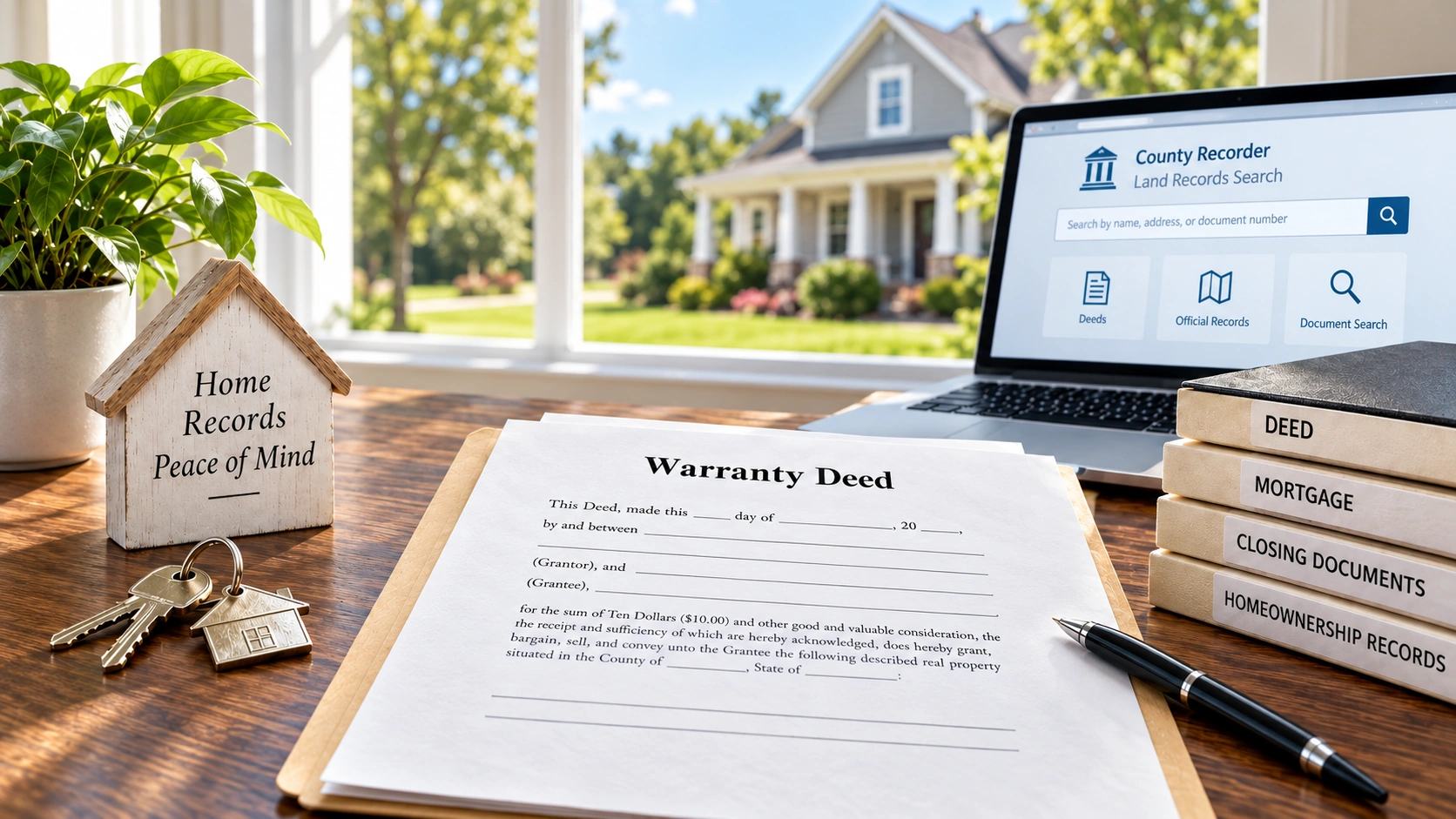
If you are trying to figure out how to get the deed to your house, you usually do not need to create a new deed. In most cases, you need to find the deed that was already recorded when you bought or otherwise acquired the property and request a copy from the local office that maintains land records.
That office may be called the recorder, register of deeds, county clerk, clerk-recorder, land records division, or something similar. The exact name, search system, copy options, fees, and record coverage vary by state and locality.
The first question is what you actually need:
| Your situation | Best next step |
|---|---|
| You only want to view the deed | Search the local recorded land records |
| You want a copy for your files | Download or request an ordinary copy if available |
| A court, agency, lender, title company, or other recipient asks for certification | Request a certified copy from the recording office |
| You want to add or remove an owner, transfer the property, or change the deed | Treat this as a legal ownership transaction, not a copy request |
That last distinction matters. Getting a copy of an existing recorded deed is not the same as preparing or recording a new deed. If your goal is to change ownership, correct substantive deed language, handle an inheritance, or transfer the home into or out of an entity or trust, state-specific legal requirements may apply.
This guide focuses on the simpler homeowner task of finding the deed already recorded for your property, obtaining the right type of copy, and knowing what to do if you cannot find it.
How to Get the Deed to Your House
For an existing homeowner, the process usually follows five steps:
- Identify the local office that records real estate documents for the county or jurisdiction where the property is located.
- Search the office’s land-record system for the deed.
- Use the owner’s name, recording information, parcel data, or other available search fields to identify the correct document.
- Decide whether you need an ordinary copy or a certified copy.
- Request or download the copy using the methods the office provides.
The property location determines which land-record system matters. If you live in one county but own a house in another, you normally need the records office serving the property, not the county where you currently live.
Procedures are not uniform nationwide. For example, Fairfax County’s land-records office requires specific recording information when ordering copies, while King County’s Recorder’s Office provides online, phone, mail, and in-person options for many recorded documents.
Use the official government website for the property location as your starting point rather than assuming another county’s system works the same way.
What Is the Recorded Deed to Your House?
A deed is the document used to transfer ownership of real estate from one party to another.
At a typical home purchase, the seller signs the deed transferring the property to the buyer, and the deed is recorded in the public land records as part of the closing process. The Consumer Financial Protection Bureau explains that the seller signs the deed transferring legal ownership and that the settlement process includes recording real estate documents.
The recorded deed is different from the concept of title. Title refers to legal ownership rights in the property. The deed is a document used to transfer those rights.
If you want a deeper explanation of title searches, title defects, lender coverage, and owner protection, see our guide to title insurance.
The deed is also different from your mortgage documents.
A mortgage or deed of trust is generally a security instrument connected to a loan. The deed documents the ownership transfer. The CFPB’s post-closing guidance treats the deed and the mortgage or deed of trust as separate key documents homeowners should keep.
For a homeowner who already owns the house and only needs a copy of the deed, the important point is simple: you are usually looking for the recorded ownership document, not trying to recreate the closing transaction.
Where Is Your Property Deed Recorded?
Real estate records are maintained locally, but the responsible office does not have one universal name across the United States.
Depending on where the property is located, you may encounter an office called:
- Recorder of Deeds;
- County Recorder;
- Register of Deeds;
- County Clerk;
- Clerk-Recorder;
- Clerk of Court;
- Land Records Division; or
- another local recording office.
Search for the official government website for the county or jurisdiction where the property is located and look for terms such as land records, recorded documents, deeds, real estate records, or recorder.
Do not assume the tax assessor and the recorder perform the same job.
The assessor’s office may help you identify the parcel, owner name, legal description, or a deed reference. The recorder or land-records office is generally where recorded deeds and related documents are maintained.
That difference becomes useful if the recorder’s system cannot search by street address. You may be able to use the assessor’s property information first, then use the resulting owner name, parcel data, instrument number, or recording reference to locate the deed.
How to Look Up Your Property Deed
The easiest search method depends on the local system and how much information you already have.
Start With the Local Land-Records Search
Go to the official recorder, register, clerk, or land-records website for the property location.
Look for an online search tool labeled something like:
- recorded documents;
- official records;
- land records;
- real estate records;
- document search; or
- deed search.
Some jurisdictions provide document images online. Others provide only an index or reference number, after which you must request the copy separately.
Older records may not be fully digitized. King County’s recorded-document guidance is a useful example of why record age matters. The county directs recent records to its online recorder system while older deeds may require archival research.
So if an online search does not show your deed, do not immediately conclude that the deed was never recorded.
Search by Owner or Grantee Name
Many land-record systems are indexed by the names of parties on the document. For the deed by which you acquired the property, you were generally the grantee, meaning the person receiving the ownership interest.
Try the name exactly as it may have appeared at the time of purchase. Depending on the system, you may need to search:
- your current name;
- a former name;
- a spouse or co-owner’s name;
- a trust name;
- a business or entity name; or
- the prior owner’s name.
Be careful with common names. Use other information such as the recording date, legal description, parcel data, or document type to confirm that you have the right deed.
Use the Property Address or Parcel Record to Find the Deed Reference
Some recorder systems allow address or parcel searches. Others do not. If the recorder does not accept a street address, check the local assessor or property-information system. The property record may provide information that points you toward the recorded deed, such as:
- current owner name;
- parcel or tax identification number;
- legal description;
- sale date;
- recording number;
- document number; or
- deed book and page.
Do not confuse a parcel number with a recording or instrument number. A parcel number identifies the property for assessment or tax purposes. A recording number identifies a particular recorded document.
Search by Instrument Number, Document Number, or Book and Page When Available
If you already have a recording reference, the search becomes easier. Depending on the jurisdiction and age of the deed, that reference may be called:
- instrument number;
- recording number;
- document number;
- auditor’s number;
- deed book and page; or
- another local identifier.
Closing paperwork, a prior deed copy, a title document, or the assessor’s record may contain that information.
Fairfax County, for example, asks for the instrument number or deed book and page when ordering land-record copies. That is an example of why keeping closing records can save time years later.
If you recently bought the home, our new homeowner checklist explains how to organize closing and ownership records so they are easier to retrieve later.
How to Request a Copy of Your House Deed
Once you identify the correct deed, follow the recording office’s instructions for obtaining a copy.
Common options include:
- downloading an unofficial or ordinary copy online;
- ordering a copy through an online portal;
- requesting a copy by mail;
- requesting a copy by phone where offered; or
- visiting the office in person.
Not every jurisdiction offers every method.
Before ordering, confirm:
- the document is the correct deed;
- the owner’s name matches what you expect;
- the property description or other identifying information appears correct;
- the recording date makes sense;
- whether you need a regular or certified copy;
- the copy fee;
- any certification fee;
- accepted payment methods; and
- how the office will deliver the document.
Avoid relying on a national estimate for deed-copy cost. Local governments set their own fees and procedures, and those can change.
If the official website is unclear, contact the records office directly and ask what information it needs to locate your deed.
Regular Copy vs. Certified Copy of a Deed
A regular copy and a certified copy are not always interchangeable.
Regular or Uncertified Copy
A regular copy reproduces the recorded deed without the formal certification of the recording authority.
Depending on the jurisdiction, you may be able to:
- view it online;
- print a watermarked copy;
- download an image or PDF;
- order an uncertified copy; or
- obtain a photocopy in person.
For your own records, research, or general reference, an ordinary copy may be enough.
Certified Copy
A certified copy includes the recording office’s certification that the copy corresponds to the recorded document in its custody.
You may need a certified copy when a specific recipient requires official certification, such as in some:
- court matters;
- government applications;
- title or real estate transactions;
- estate matters;
- legal proceedings; or
- institutional requests.
Do not automatically pay for certification if no one has asked for it. Ask the person or organization requesting the deed whether an ordinary copy is acceptable. Then follow the recording office’s procedure if certification is required.
King County, for example, distinguishes between certified and uncertified copies in its official copy-request system. That illustrates the practical difference without creating a universal rule for every jurisdiction.
What Information Do You Need to Find Your Deed?
The more identifying information you have, the easier the search usually becomes. Useful information may include:
- the name of the current owner or owners;
- the name used at the time the property was acquired;
- the prior owner’s name;
- property address;
- parcel or tax identification number;
- approximate purchase date;
- approximate recording date;
- legal description;
- instrument or document number; and
- deed book and page.
You may not need all of these. One county may allow a name search. Another may require a recording number before it will process a copy order. Older records may require a grantor-grantee index, book and page reference, or help from an archives office.
If you do not know the deed reference, start with what you do know and work outward. For example:
- Search the property address in the assessor’s system.
- Confirm the owner’s name and parcel.
- Look for a sale date or recorded-document reference.
- Use that information in the recorder’s system.
- Contact the recorder if the document still cannot be located.
That approach is usually more productive than repeatedly entering the street address into a recorder system that is not indexed by address.
What If You Cannot Find Your Deed Online?
A failed online search does not necessarily mean there is a title problem. There are several ordinary explanations.
The Deed May Be Too Old for the Online System
Some counties have digitized recent records but keep older deeds on microfilm, in bound books, or in archives.
King County, for example, separates older recorded property documents from more recent online records. Other jurisdictions use different cutoff dates.
Check the recorder or archives website for the date range covered by the online database.
The Deed May Be Indexed Under a Different Name
The deed might appear under:
- a spouse or co-owner;
- a prior legal name;
- a trust;
- an LLC or other entity;
- a different spelling; or
- the prior owner as grantor.
Try alternate names that legitimately relate to the transaction.
The Recorder May Not Index by Address
A street address is convenient for homeowners but is not necessarily the legal indexing method used by the recorder.
Use the assessor’s database or property-information system to find the name, parcel, legal description, or recording reference first.
The Deed May Have Been Recorded Recently
If your closing was recent, the recording may not yet be fully available in every public-facing search system.
Ask the closing or settlement provider whether the deed was submitted for recording and, if available, request the recording number.
Do not assume a specific nationwide posting time. Recording and indexing procedures vary by jurisdiction.
You May Be Searching the Wrong Office
Some states and localities use a county recorder. Others use a register of deeds, clerk, court, or another office.
Confirm which local government office records real property documents where the land is located.
You May Need Help From the Records Office
If you have tried the available online tools and still cannot locate the deed, contact the office that maintains the land records.
Provide the information you have, such as:
- property address;
- owner names;
- approximate purchase date;
- parcel number; and
- prior owner name.
Staff may be able to explain the search process or tell you which index covers the record.
If the office cannot locate a deed that you expected to be recorded, or if the public record appears inconsistent with your ownership documents, that is a different problem from simply not finding the right search screen. Consider contacting the closing or title professional involved in the transaction or a qualified real estate attorney.
What If You Lost the Original Deed to Your House?
Losing the paper deed that was in your personal files usually does not mean the recorded land record disappears.
If the deed was properly recorded, the recording office maintains the public record according to its own retention system.
Your practical first step is therefore to find and obtain a copy of the recorded deed. This distinction is important:
Lost personal copy: you no longer have the paper or electronic version you kept at home.
Missing or disputed recorded deed: the public record does not show the document you expected, ownership appears inconsistent, or there is a substantive dispute about the property.
The first situation is generally a records-retrieval problem.
The second may require help from the settlement provider, title company, attorney, or another professional familiar with local real estate records.
Also remember that recording offices do not all handle the physical original document in the same way. Some record and return documents; others maintain images or archives under local procedures. Avoid assuming the county permanently stores the exact paper you signed.
Does the Bank Hold the Deed to Your House?
A mortgage lender does not universally “hold your deed” until the loan is paid off.
That statement confuses different documents and can be misleading because mortgage law and security instruments vary by state.
In a typical financed purchase, you may encounter:
The deed: the document used to transfer ownership to you.
The promissory note: your promise to repay the loan.
The mortgage or deed of trust: the security instrument that gives the lender or another secured party rights connected to the property if the loan is not repaid as agreed.
The CFPB lists the deed, promissory note, and mortgage or deed of trust as separate closing documents.
So if you have a mortgage and want a copy of your deed, the practical place to start is usually the public land records, not a request asking the lender to “give you the deed.”
There are exceptions and different forms of real estate financing. The Consumer Financial Protection Bureau explains that a contract for deed is a different arrangement in which the seller retains legal title until the buyer completes the required payments. Do not assume rules for a conventional mortgage apply to every form of home financing.
Do You Get a New Deed When You Pay Off Your Mortgage?
Paying off a typical mortgage does not usually mean you receive a brand-new ownership deed simply because the loan balance reached zero.
You generally obtained your deed when ownership was transferred to you. What changes after mortgage payoff is the status of the lender’s security interest.
The document showing that the mortgage or deed of trust has been satisfied may be called a:
- release;
- satisfaction;
- reconveyance;
- discharge; or
- another jurisdiction-specific term.
The Pima County Recorder’s Office explains this distinction directly: homeowners received their deed when they purchased the property, while after payoff they can check whether the release or reconveyance has been recorded.
Terminology and procedures vary by state and locality, so check the land records for your property rather than assuming one document name applies everywhere.
If you recently paid off a mortgage and expected a release but cannot find one, contact the lender or servicer and the local recording office to understand the status and local process.
How to Check Whether the Recorded Deed Looks Correct
Once you find the recorded deed, confirm that it appears to be the document associated with your property and transaction.
Basic details you can review may include:
- names of the grantor and grantee;
- recording date;
- execution date where shown;
- property or legal description;
- instrument, document, or book-and-page reference;
- return-address information where shown; and
- document type.
Do not assume that a street address alone is enough to verify the legal description of the property. Also distinguish between spotting an obvious discrepancy and deciding whether the deed is legally valid.
For example, you may be able to notice that your name is misspelled, the document appears to involve a different parcel, or a co-owner you expected to see is absent. But determining the legal effect of a mistake can depend on state law and the transaction.
A recorder’s office generally records documents that meet its recording requirements. It does not necessarily decide whether the document correctly resolves every ownership question.
If something substantive appears wrong, contact the professional who prepared or handled the deed, the title or settlement provider, or a qualified real estate attorney.
When Getting a Copy Is Not Enough
Stop treating the problem as a simple deed-copy request if your real goal is to change legal ownership or alter the recorded instrument.
Examples include:
- adding a spouse or another owner;
- removing an owner;
- transferring the property to a child or other family member;
- transferring the property into or out of a trust;
- transferring property to or from a business entity;
- changing how co-owners hold title;
- correcting substantive deed language;
- handling ownership after a death;
- dealing with probate or inheritance;
- resolving competing ownership claims; or
- replacing a deed because the existing legal instrument is defective.
Those actions can affect ownership rights, taxes, estate planning, creditor rights, mortgage terms, insurance, and other legal interests.
A county recorder may provide blank forms or explain recording requirements, but that does not mean the office can tell you which deed to use or how to structure the transfer.
If you need to create or change a deed, use qualified state-specific legal guidance, rather than copying language from an unrelated property’s deed or a generic online template.
For readers still in the purchase process, our how to buy a house guide explains how title work, closing, and ownership transfer fit into the broader transaction.
Watch for Deed-Copy Solicitations and Unnecessary Charges
Homeowners sometimes receive mail that looks official and offers to obtain a deed or other property record for a substantial fee.
The fact that a company knows your name, address, lender, purchase date, or loan amount does not necessarily mean it is connected to your lender or local government.
The CFPB warns homeowners that deeds and mortgage-related information become public records after closing and that companies can use that information for advertising or scams that appear connected to a lender.
Before paying a private company to obtain a deed:
- Find the official land-records office for your property.
- Check whether you can view or download the record yourself.
- Check the government’s ordinary and certified-copy fees.
- Decide whether you actually need a certified copy.
- Compare any private service against the official option.
A private records service is not automatically fraudulent. Some people may choose to pay for convenience.
The key is to know that the deed may already be available directly from the public office at a lower cost, and that a solicitation is not necessarily an official government notice.
Frequently Asked Questions About Getting Your House Deed
Can I Get a Copy of My Property Deed Online?
Often, but not always. Many recording offices provide online searches and document images. Some allow you to download unofficial copies, while others let you order certified or uncertified copies through an online portal.
Older records may not be digitized, and some jurisdictions require mail or in-person requests. Start with the official land-records website for the property location and check the record coverage and copy options.
Is a Property Deed a Public Record?
Recorded deeds are generally maintained as public land records, subject to applicable law and the recording system used by the jurisdiction.
For example, King County describes recording as filing deeds and other real estate documents to create a public record of property ownership changes.
Access methods vary. A document may be searchable online, available only through an index, stored in an archives collection, or obtainable by request.
How Much Does It Cost to Get a Copy of a Deed?
There is no single nationwide fee. The cost can depend on:
- jurisdiction;
- number of pages;
- ordinary versus certified copy;
- delivery method;
- online service fees; and
- local fee schedules.
Check the official records office before paying a third party.
Do I Need a Certified Copy of My Deed?
Not necessarily. For personal records or general reference, an ordinary copy may be enough.
If a court, agency, lender, title company, attorney, or other recipient asks for the deed, ask whether it specifically requires a certified copy.
If certification is required, request it from the government office that maintains the recorded document.
Who Holds the Deed to My House if I Have a Mortgage?
Do not assume your mortgage lender simply holds the ownership deed until payoff. The deed, promissory note, and mortgage or deed of trust perform different functions.
If you need a copy of the recorded deed, search the local land records where the property is located. If your financing arrangement is unusual, such as a contract for deed, the ownership structure may be different.
What Happens if I Cannot Find My Property Deed?
First check whether:
- you are using the correct county or jurisdiction;
- the deed is indexed under a different owner name;
- the recorder requires a document number rather than an address;
- the assessor can provide the parcel or deed reference;
- the deed is older than the online database;
- the record is still being processed after a recent closing; or
- an archives office maintains older documents.
If the responsible public office cannot locate a deed you expected to exist, contact the closing or title professional involved in the transaction or get qualified legal help.
Can the Recorder Change a Name or Mistake on My Deed?
Do not assume the recorder can simply edit a recorded deed. Recording offices generally preserve recorded documents. Changing ownership or correcting a substantive problem may require a new corrective or conveyance document under state law.
If you see an error, first determine whether it is merely a search-index issue or an issue in the recorded document itself.
For a substantive deed problem, contact the deed preparer, title or settlement professional, or a qualified real estate attorney.
How Long After Closing Does a Recorded Deed Become Available?
There is no universal U.S. timeline. The closing or settlement agent may submit the deed for recording as part of the transaction, but the time until it appears in a public search system or until an original document is returned depends on the jurisdiction and process.
If your closing was recent, ask the settlement provider whether recording has been completed and whether it can provide the recording or instrument number. Then confirm availability with the local recording office.
Keep Your Deed With Your Other Homeownership Records
Once you obtain the deed, save it with the records you may need throughout homeownership. The CFPB recommends keeping the deed along with other important closing documents such as the Closing Disclosure, promissory note, and mortgage or deed of trust.
A practical home-record system might include:
- deed;
- Closing Disclosure;
- promissory note;
- mortgage or deed of trust;
- title insurance policy;
- property survey if available;
- homeowners insurance records;
- property-tax records;
- HOA or condominium documents where applicable;
- permits and major improvement records; and
- mortgage payoff or release documents when applicable.
Keep secure backups of important electronic records.
If you recently closed and are still organizing the first weeks and months of ownership, use our new homeowner checklist to build a broader system for mortgage, insurance, maintenance, tax, repair, and property records.
Know Whether You Need a Copy or a Legal Change
The simplest answer to how to get the deed to your house is to start with the official land-records office where the property is located.
Find the recorded deed using the search information your jurisdiction accepts, confirm that you have the correct document, and request an ordinary or certified copy based on what you actually need.
If the deed does not appear online, check older archives, alternate owner names, the assessor’s property record, or the recording office’s search requirements before assuming something is wrong.
And keep the central distinction clear: retrieving an existing recorded deed is a records task; changing the deed or changing ownership is a legal transaction.
Knowing which problem you actually have will save time, reduce unnecessary fees, and help you go to the right office or professional from the beginning.