
Title Insurance: What It Is, What It Covers & Whether You Need It
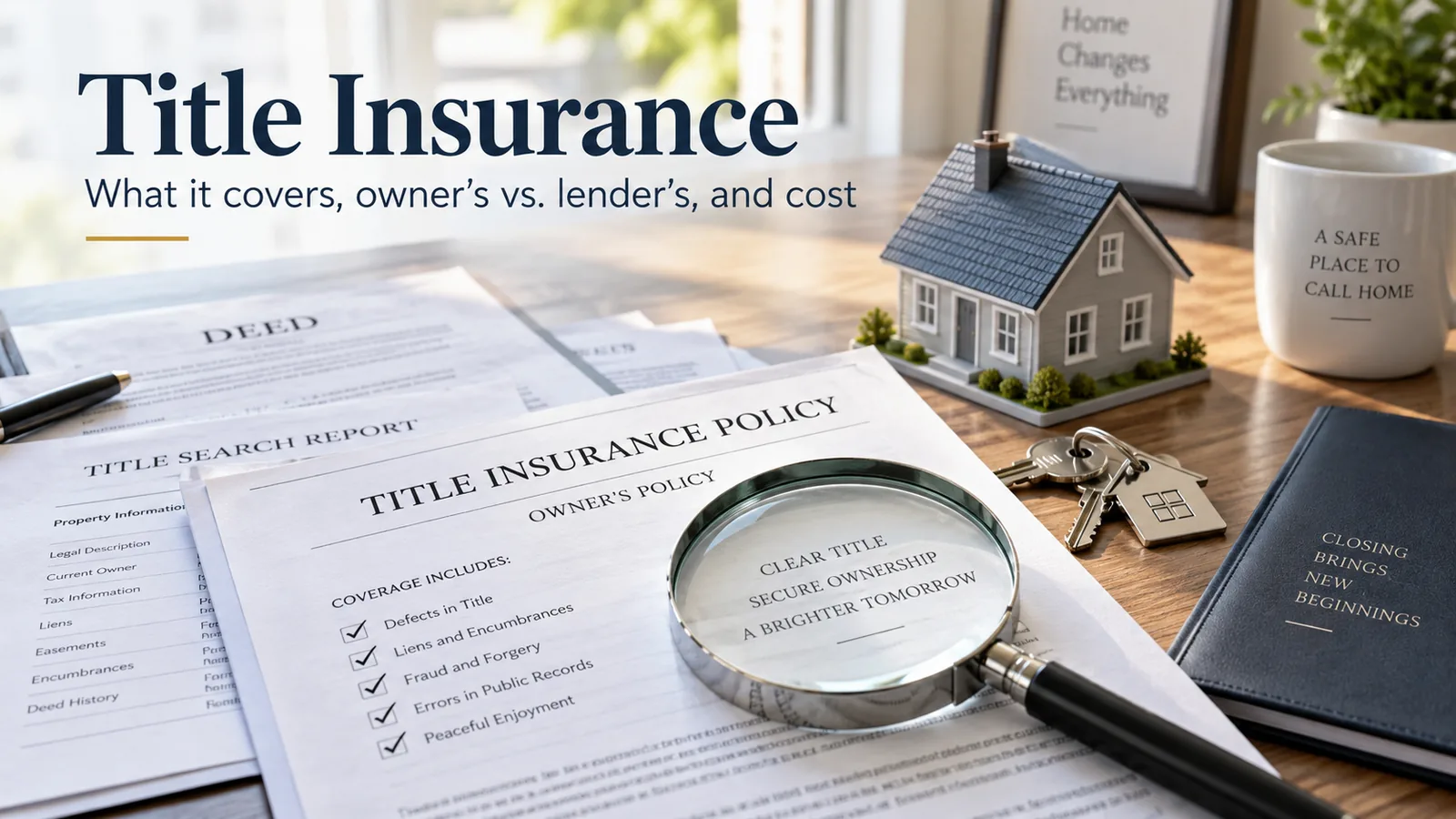
Title insurance protects against certain problems with legal ownership of a property that existed before you bought or financed it.
That makes it different from most insurance.
Homeowners insurance generally protects against certain future events, such as covered damage after you own the home. Title insurance primarily deals with covered title problems rooted in the past. These problems may already exist even if nobody discovered them before closing.
Those problems can include issues such as:
- an undisclosed lien;
- unpaid taxes connected with a prior owner;
- errors in recorded documents;
- forged documents;
- competing ownership claims;
- undisclosed heirs;
- or other defects affecting ownership rights.
But title insurance does not mean every ownership dispute is covered. The exact policy matters. You also need to distinguish between the lender’s title insurance and the owner’s title insurance, because they protect different financial interests.
This guide explains how title insurance works, how it relates to the title search, what lender and owner policies protect, how costs can vary, what exclusions and exceptions mean, and what to review before closing.
Title Insurance: The Short Answer
When you buy a home, you expect the seller to transfer valid ownership rights to you. A title search is performed to identify problems that may affect that ownership. Known problems can then be addressed before closing.
Title insurance provides another layer of protection by covering certain title defects under the terms of the policy, including some problems that may not have been discovered during the title search.
There are two main types of title insurance in a financed home purchase: lender’s title insurance and owner’s title insurance.
A lender generally requires a lender’s policy when you finance a home. An owner’s policy is generally optional. And buying the lender’s policy does not mean your own financial interest in the home is insured.
What Does “Title” Mean When You Buy a House?
In real estate, title refers to your legal ownership rights in the property. The deed is the document generally used to transfer ownership from the seller to the buyer, but valid ownership can depend on more than simply having a signed deed.
For example, public records might reveal:
- an existing mortgage;
- a tax lien;
- a judgment;
- an easement;
- restrictions;
- a prior ownership interest;
- or another recorded matter affecting the property.
There can also be title problems that are difficult to identify in the records available before closing. That is why a real estate transaction often involves both:
- a title search and title-clearing process; and
- title insurance.
They perform related but different jobs.
What Is a Title Search?
A title search is an examination of records related to the property and its ownership history. Depending on the transaction and location, title professionals may examine records for matters such as:
- current ownership;
- previous transfers;
- mortgages;
- liens;
- judgments;
- unpaid property taxes;
- easements;
- restrictions;
- recorded claims;
- and other matters that may affect title.
The goal is to identify defects or encumbrances that could interfere with the transfer or the lender’s security interest.
If an issue is found, it may need to be resolved before the transaction can close or before the title insurer will issue the proposed coverage.
For example, an existing mortgage belonging to the seller may need to be paid and released. An unpaid lien may need to be resolved. A document error may need to be corrected.
The search therefore helps prevent known title problems from following the buyer into ownership. But it does not make hidden problems impossible.
Title Search vs. Title Insurance
| Title Search | Title Insurance |
|---|---|
| Examines records and ownership history before closing | Provides protection against covered title risks under the policy |
| Tries to identify existing problems | Addresses covered losses if an insured problem later emerges |
| Helps known defects get resolved before closing | Can address certain defects that were not discovered before closing |
| It is part of the due diligence and underwriting process. | Is an insurance contract |
| Cannot guarantee that every hidden problem will be discovered | Does not cover every possible ownership or property issue |
The simplest way to think about it is: The title search tries to find problems. Title insurance deals with certain covered problems that remain or emerge later.
How the Title Protection Process Works
The process can vary by state and transaction, but the general sequence looks like this.
1. Public Records Are Reviewed
The title company, attorney, abstractor, or other professional involved in the transaction reviews relevant records.
The goal is to determine who appears to own the property and what recorded matters affect it.
2. Known Title Problems Are Identified
The search may uncover:
- liens;
- unpaid mortgages;
- tax issues;
- ownership inconsistencies;
- document defects;
- restrictions;
- easements;
- or other matters affecting title.
3. Problems That Must Be Cleared Are Addressed
Certain issues may need to be paid, released, corrected, documented, or otherwise resolved before closing.
The specific process depends on the issue, applicable law, contract, insurer requirements, and transaction professionals involved.
4. A Title Commitment or Preliminary Report May Be Prepared
Depending on the state and local process, you may receive a title commitment, preliminary report, or similarly named document.
It can show:
- who is expected to be insured;
- the property being insured;
- requirements that must be satisfied;
- matters affecting title;
- and exceptions that may not be covered by the proposed policy.
5. The Title Policies Are Issued
A financed transaction commonly includes a lender’s policy. The buyer may also purchase an owner’s policy.
6. A Covered Title Problem May Be Addressed Under the Policy
If an insured title problem later appears, the insured party can follow the policy’s claim procedures.
Whether the insurer provides a defense, pays a covered loss, resolves the issue another way, or denies the claim depends on the policy and circumstances.
Lender’s Title Insurance vs. Owner’s Title Insurance
These policies should not be confused.
| Question | Lender’s Policy | Owner’s Policy |
|---|---|---|
| Who is insured? | Mortgage lender | Homeowner / named insured |
| Usually required with a mortgage? | Generally yes | Generally no |
| Protects the buyer’s equity? | No | Can protect the owner’s insured interest |
| Policy amount generally relates to | Mortgage amount | Commonly purchase price / insured ownership interest |
| How premium is generally paid | One-time premium | One-time premium |
| How long protection generally lasts | While the insured loan interest continues, subject to policy | Generally while the insured owner retains the covered interest, subject to policy |
The exact policy controls.
What Is Lender’s Title Insurance?
Lender’s title insurance protects the lender against covered problems with the property’s title that could threaten the lender’s security interest.
Mortgage lenders generally require this coverage. The CFPB’s lender’s title insurance guidance explains that this policy protects the lender’s financial interest, not the buyer’s equity.
Suppose you borrow money to buy a home and another person later establishes a valid ownership claim arising from circumstances that existed before your purchase.
That kind of dispute could also threaten the mortgage lender’s interest in the property. The lender’s title policy is designed to protect the lender against covered risks. But there is an important limitation for the buyer:
The lender’s policy does not insure your equity just because you paid for it. You and the lender have different financial interests. That is why owner’s coverage exists separately.
If you are still learning how lender requirements fit into the broader financing process, our guide to how to get a mortgage explains the mortgage sequence from application through closing.
What Is Owner’s Title Insurance?
Owner’s title insurance protects the homeowner’s insured financial interest against covered title problems, subject to the policy.
Examples of claims that may be relevant include certain problems arising from:
- unpaid taxes belonging to a prior owner;
- unpaid contractor claims;
- unknown liens;
- fraud;
- forgery;
- mistakes in recorded documents;
- or competing ownership claims.
These are examples, not promises of coverage. A specific claim is covered only if it falls within the policy terms and is not excluded or excepted.
An owner’s policy is generally optional. The CFPB’s owner’s title insurance guidance explains how owner’s coverage can protect the homeowner’s financial interest against certain covered title claims that existed before the purchase.
That means the decision should be based on understanding the protection you are buying rather than assuming it is universally required or universally unnecessary.
Why Title Insurance Is Different From Most Insurance
Many familiar insurance policies focus on future events.
For example:
- Homeowners insurance can cover certain property losses after the policy starts;
- Auto insurance can cover certain accidents that happen during the policy period.
Title insurance works differently. It primarily addresses covered title defects rooted in circumstances that existed before the policy date. For example, imagine that a prior ownership document contained a forged signature years before you bought the home.
If that problem was not discovered during the title search and later produces a valid claim, whether your loss is covered depends on your title policy.
The important distinction is that the problem may surface in the future even though the underlying defect occurred in the past.
What Does Title Insurance Cover?
Coverage varies by policy. Depending on the policy and circumstances, covered risks may include certain losses involving:
- unknown liens;
- certain unpaid taxes;
- forgery;
- fraud affecting title;
- errors in deeds or public records;
- unknown heirs;
- undisclosed ownership interests;
- improperly executed documents;
- or other covered defects affecting ownership.
Some policies may also provide additional protection through endorsements or enhanced forms. Do not assume a general list on the internet tells you exactly what your policy covers. Please read the actual policy and proposed exceptions.
What Title Insurance May Not Cover
Title insurance does not insure every risk connected with owning a property.
A policy can contain:
- exclusions;
- exceptions;
- conditions;
- limitations;
- and other provisions affecting coverage.
Some matters may be identified before closing and specifically excluded from coverage. Other categories of risks may be excluded by the standard policy. Certain problems created or agreed to by the insured may also fall outside coverage.
And many ordinary property-condition problems are not title-insurance issues at all. For example, title insurance should not be confused with protection against:
- a leaking roof;
- a defective HVAC system;
- ordinary maintenance;
- many environmental conditions;
- routine homeowners insurance losses;
- or problems that belong within the inspection process.
Covered Risk vs. Exception vs. Exclusion
| Item | What It Means | What the Buyer Should Verify |
|---|---|---|
| Covered risk | A title risk the policy agrees to insure, subject to its terms | Understand the scope and policy limit. |
| Exception | A specific matter excluded from the proposed coverage | Identify what is being excepted before closing |
| Exclusion | A category of risk outside the policy’s coverage | Understand the policy limitations. |
| Requirement / cure item | Something that must be resolved before the proposed policy can issue | Confirm it is properly satisfied |
| Endorsement | An addition or modification to policy coverage | Understand what protection it adds or changes. |
This distinction is important.
A title company may know about a matter and still issue a policy that specifically excepts that matter from coverage. The existence of title insurance, therefore, does not mean every item shown in the title work disappears.
What Is a Title Commitment or Preliminary Report?
Terminology varies across the United States. Depending on the state, transaction, and title system, you may receive a document called:
- a title commitment;
- a preliminary title report;
- a preliminary report;
- or another similar term.
This document generally describes the title as the insurer proposes to insure it and identifies conditions that must be satisfied before the policy is issued.
It can also identify exceptions that will remain outside coverage. It is not something to ignore simply because the closing professional has reviewed it.
What Should You Check Before Closing?
When you receive the title commitment, preliminary report, or equivalent document, review items such as:
- your name as proposed insured;
- the seller or current ownership information;
- the property address;
- the legal description where provided;
- the proposed owner policy amount;
- the proposed lender policy amount;
- liens or mortgages that must be released;
- easements;
- restrictions;
- recorded encumbrances;
- exceptions;
- requirements that must be completed before closing;
- endorsements;
- and any title matter you do not understand.
A technical-looking entry should not automatically be treated as harmless. Ask the title or closing professional what it means. If an issue affects legal ownership rights and the explanation is still unclear, a qualified real estate attorney may be appropriate.
A Hypothetical Example: Search vs. Insurance
Suppose the title search finds an unpaid contractor lien from work completed for the previous owner.
Because the lien is discovered before closing, the transaction professionals may require that it be paid, released, insured over where legally and contractually appropriate, or otherwise addressed before the transaction proceeds.
Now imagine a different situation. A prior title defect existed before closing but was not found in the records reviewed.
Months after the buyer takes ownership, another party asserts a claim based on that defect. At that point, the owner would need to review the title policy and follow its claim procedures.
Whether the insurer provides coverage would depend on:
- the nature of the claim;
- the insured party;
- the policy language;
- applicable exclusions;
- exceptions;
- endorsements;
- and other facts.
The example shows the difference. The title and closing process usually addresses known problems. Covered hidden problems are where the insurance policy may become important.
How Much Does Title Insurance Cost?
There is no single national price for title insurance. U.S. Treasury has cited CFPB estimates indicating title insurance premiums often fall broadly around 0.5% to 1.0% of the purchase price.
That is only a general benchmark. It is not a quote for your transaction.
Actual costs can depend on:
- state regulation;
- purchase price;
- mortgage amount;
- policy type;
- owner-policy amount;
- lender-policy amount;
- endorsements;
- whether the policies are issued together;
- prior policy or reissue rules where applicable;
- title search charges;
- settlement services;
- and how different services are bundled.
In some states, insurance rates are heavily regulated. In others, the pricing structure can operate differently. The amount you actually pay should come from the transaction-specific quote and closing documents.
Title Insurance Premium vs. Other Title Costs
A common source of confusion is assuming every charge from a title company is the title insurance premium. It may not be. Your transaction could include separate charges for:
- lender’s title insurance;
- owner’s title insurance;
- title search;
- title examination;
- settlement or closing service;
- endorsements;
- closing-protection services;
- document preparation;
- or other title-related work.
The same company may also collect government fees or other transaction charges that are not insurance premiums. When comparing quotes, identify what each charge actually represents.
What Is Simultaneous-Issue Pricing?
When lender’s and owner’s title policies are issued as part of the same purchase transaction, the combined price may sometimes be lower than buying the two policies independently.
CFPB specifically notes that buying owner’s coverage from the same provider handling the lender’s policy can reduce the combined cost.
That means the most useful question may not be, ‘How much is owner’s title insurance by itself?’ A better question may be, ‘What additional amount will I actually pay for the owner’s coverage if both policies are issued together?’
The answer depends on the transaction and applicable state pricing rules.
Is Title Insurance Part of Closing Costs?
Yes, title insurance and related title services can form part of the costs associated with closing a financed home purchase. But title-related charges are only one part of the broader closing-cost picture.
For a full explanation of loan costs, other costs, credits, deposits, prepaids, down payments, and cash to close, see our buyer closing costs guide.
Where Does Title Insurance Appear on the Loan Estimate?
Title-related services may appear in different areas of the mortgage disclosures depending on whether the lender requires the service and whether the consumer is permitted to shop for the provider.
Lender title services can appear among services the borrower cannot or can shop for.
The owner’s title insurance is disclosed separately when applicable. The title company’s invoice or itemized statement may also present the costs differently from the Loan Estimate or Closing Disclosure.
A difference in presentation does not automatically mean the total is wrong. Compare the bottom-line title costs and ask about unexplained differences.
Can You Shop for Title Insurance?
Often, yes. The CFPB’s title-insurance and closing-services shopping guidance advises buyers to review which services they can shop for and to compare providers on the overall cost of title and closing services.
CFPB advises buyers to look at the Services You Can Shop For section of the Loan Estimate and compare available title and closing-service providers.
Shopping can matter because a title transaction may involve more than the insurance premium. Compare the full package.
Ask potential providers:
- What is the lender’s policy premium?
- What is the owner’s policy premium?
- Does simultaneous-issue pricing apply?
- What title search or examination charges apply?
- What settlement or closing charges apply?
- Are endorsements included?
- Are there separate administrative charges?
- What is the bottom-line total?
- When will I receive the title commitment or preliminary report?
- Who will handle questions before closing?
Do not assume the lowest-looking individual fee produces the lowest total.
Can the Seller Make You Use a Particular Title Insurance Company?
For transactions covered by the federal Real Estate Settlement Procedures Act (RESPA), a seller cannot require the buyer, as a condition of the sale, to purchase title insurance from a particular company, as explained in the CFPB’s title-insurance choice guidance.
That does not mean that every settlement-service choice in every transaction works exactly the same way. Your lender may have requirements for certain mortgage-related services, and state closing practices vary.
But a seller conditioning the sale on your purchase of title insurance from one particular insurer is specifically restricted under federal law.
How to Compare Title Insurance Quotes
When you receive competing quotes, compare the same scope. Look at the following important things:
Lender’s policy: ______
Owner’s policy: ______
Simultaneous-issue adjustment: ______
Title search / examination: ______
Settlement / closing charge: ______
Endorsements: ______
Other title-service charges: ______
Bottom-line total: ______
Then ask:
- Are the policy amounts the same?
- Are the same endorsements included?
- Are the search and settlement services comparable?
- Are any discounts built into one quote but not another?
- Is one provider excluding services you will have to purchase elsewhere?
This makes the comparison more useful than simply asking which company has the cheapest headline premium.
Who Pays for Title Insurance?
There is no universal U.S. rule saying the buyer or seller always pays every title insurance cost. In a financed transaction, the buyer commonly encounters the cost of the lender-required title policy as part of the mortgage closing.
The owner’s policy may be paid by:
- the buyer;
- the seller;
- or according to another arrangement permitted in the transaction.
Who pays can depend on:
- state practice;
- local custom;
- the purchase agreement;
- negotiation;
- and applicable rules.
Do not rely on a generic national article to determine who must pay in your transaction. Check the contract and closing documents.
Do You Need Owner’s Title Insurance?
This is the most important decision question for many buyers. The lender’s policy is generally required when you finance the home. The owner’s policy is generally optional. That does not automatically make it necessary or unnecessary. Use a structured decision.
1. Understand What the Lender’s Policy Does Not Protect
The lender’s policy protects the lender’s insured interest. It does not substitute for an owner’s policy covering your financial interest.
2. Find the Actual Incremental Cost
If a lender’s policy is already being issued, ask how much additional money the owner’s policy would actually cost under simultaneous-issue pricing. Do not rely only on a generic percentage.
3. Read the Proposed Owner’s Coverage
Understand:
- policy amount;
- covered risks;
- exceptions;
- exclusions;
- and endorsements.
A policy is not valuable merely because it has the words “title insurance” on it.
4. Review the Title Work
Ask what issues were found. Ask what will be cured before closing. Ask what will remain as exceptions.
5. Consider the Financial Interest You Would Leave Uninsured
Your down payment and future equity can represent a substantial financial interest. The lender’s protection does not automatically protect that interest.
6. Consider the State and Transaction Structure
Rates, forms, required disclosures, available endorsements, and local title practices can differ.
7. Ask Questions Before You Decline or Accept Coverage
If you have any questions about the proposed policy, please reach out to the title professional for clarification. If the decision depends on unresolved legal ownership rights, seek appropriate legal advice.
The objective is not to produce the same answer for every buyer. It is to make sure the decision is informed.
How Long Does Title Insurance Last?
Title insurance is generally purchased with a one-time premium, rather than an annual premium like homeowners insurance.
A lender’s policy generally remains relevant while the insured lender’s covered loan interest remains in place, subject to the policy.
An owner’s policy generally protects the insured owner while that owner retains the covered ownership interest, subject to the policy terms. The policy itself controls the exact continuation of coverage.
What Happens When You Refinance?
Refinancing creates a new mortgage. The new lender will generally require its own lender’s title policy because the new lender has a new insured loan interest. That does not necessarily mean you buy a new owner’s policy simply because you refinance.
An existing owner’s policy generally concerns your ownership interest rather than the specific refinanced loan, subject to its terms. Ask the title professional how the existing owner coverage and new lender coverage apply to your refinance.
What Happens If a Title Problem Appears Before Closing?
Do not automatically assume the transaction must close anyway.
Notify or speak with the:
- title professional;
- closing or settlement professional;
- lender where relevant;
- real estate professional;
- and attorney where legal rights require interpretation.
The issue may need to be:
- paid;
- released;
- corrected;
- documented;
- investigated;
- insured in an acceptable manner;
- or otherwise addressed.
Your contractual rights depend on the purchase agreement, applicable law, deadlines, and the specific title issue. Do not assume every title problem gives every buyer the same cancellation or renegotiation right.
What Happens If a Title Problem Appears After Closing?
First, locate your owner’s title policy if you purchased one.
Review:
- the insured name;
- policy amount;
- covered risks;
- exceptions;
- exclusions;
- and claim-notice instructions.
Then contact the title insurer or claims contact listed in the policy. Provide the documentation requested. Do not assume the claim is covered before the insurer evaluates it.
If the dispute involves substantial ownership rights, litigation, or an urgent legal deadline, consider obtaining advice from a qualified real estate attorney.
Title Insurance vs. Homeowners Insurance
These are very different products. Title insurance focuses primarily on covered legal ownership defects rooted in circumstances that existed before the policy date.
Homeowners insurance generally addresses certain future losses involving the home, personal property, liability, and other covered risks after the policy begins. One does not replace the other.
Frequently Asked Questions About Title Insurance
Is Title Insurance Required?
Lender’s title insurance is generally required by mortgage lenders for financed purchases. Owner’s title insurance is generally optional.
Does Lender’s Title Insurance Protect Me?
No. The lender’s policy protects the lender’s insured financial interest. An owner’s policy is the separate product designed to protect the homeowner’s insured interest.
Is Title Insurance Paid Every Year?
Usually no. Title insurance is generally purchased with a one-time premium rather than an annual premium.
What Is a Title Defect?
A title defect is a problem that affects ownership rights or the validity or marketability of title. Examples may include liens, document errors, competing claims, fraud, forgery, or other ownership-related issues.
Does Title Insurance Cover Liens?
Certain unknown liens may be covered, depending on the policy and circumstances. A known lien identified before closing may instead need to be resolved or may be excepted from coverage. The policy controls.
Does Title Insurance Cover Boundary Disputes?
Some title policies or endorsements may address particular boundary, survey, or access risks, but coverage varies. Do not assume every boundary dispute is covered. Review the proposed policy and endorsements.
Is Title Insurance the Same as a Title Search?
No. The title search investigates ownership records and tries to identify defects. The insurance policy covers certain insured risks under its terms.
Can a Seller Pay for Owner’s Title Insurance?
Potentially. Who pays the owner’s policy can depend on state practice, contract terms, local custom, and negotiation.
Do New Construction Homes Need Title Insurance?
New construction does not eliminate title risk. The land has an ownership history, and construction can also involve contractors, subcontractors, liens, easements, financing, and other matters affecting title.
If the purchase is financed, the lender will generally require the lender’s title coverage. Whether to purchase owner’s coverage remains a separate buyer decision.
Can I Choose the Title Company?
Buyers may be able to shop for title and closing services, depending on the service, lender requirements, state rules, and transaction.
Review the Loan Estimate and ask which services you are permitted to shop for.
Before You Close
Before closing, make sure you understand what title insurance you are buying and what it does.
Confirm:
- Which title company is handling the transaction
- whether the lender’s coverage is being issued;
- whether the owner’s coverage is included;
- the policy amounts;
- the title search results;
- the title commitment or preliminary report;
- requirements that must be completed;
- policy exceptions;
- major exclusions;
- endorsements;
- the owner-policy incremental cost;
- title search and settlement charges;
- the bottom-line title-services total;
- and how the final amounts appear on your closing documents.
If something affecting ownership is unclear, ask before you sign.
Title insurance cannot eliminate every property risk. But understanding the title search, the proposed policy, the exceptions, and the costs can help you make a far more informed decision about protecting your ownership interest.
For the broader sequence of title work, financing, insurance, final documents, walkthrough, and closing, continue with our guide to what happens after an offer is accepted on a house.
For a detailed breakdown of how title charges fit with your down payment, credits, deposits, and final amount due, see our buyer closing costs guide.
And if you want the full purchase journey from preparation through ownership, continue with our step-by-step guide to how to buy a house.