
Earnest Money: What It Is, How Much to Pay & What Happens to It
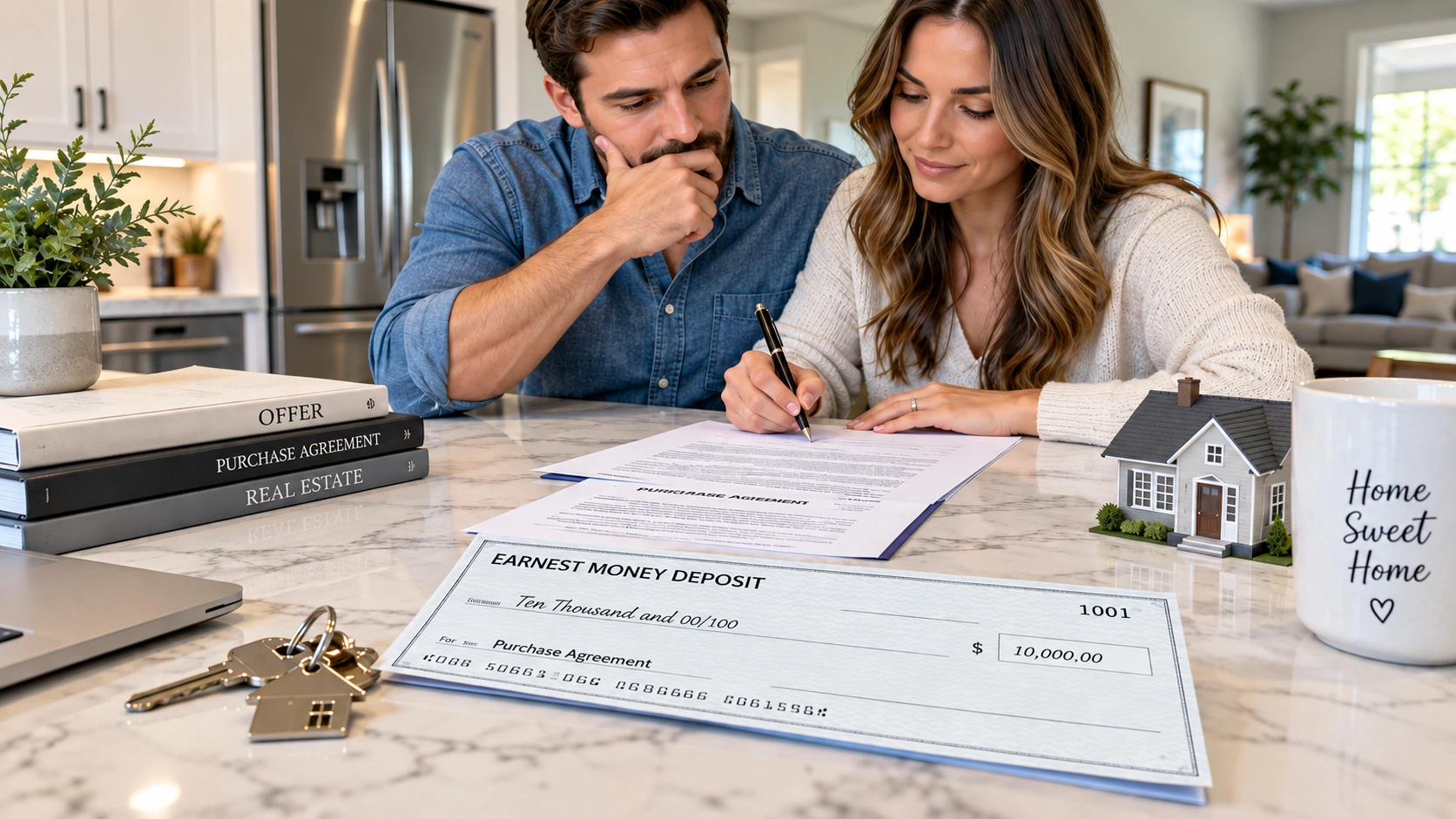
Earnest money is a deposit a homebuyer provides in connection with a purchase agreement to show that the offer is serious. It is sometimes called a good-faith deposit.
The money is usually delivered early in the transaction, after or in connection with an accepted offer, and held according to the purchase agreement until the sale closes or the contract ends.
If the purchase closes successfully, the earnest-money deposit generally does not become an extra fee. It is typically credited toward the buyer’s required funds, such as the down payment or closing costs.
If the transaction does not close, however, whether the buyer receives the money back can depend on:
- the purchase agreement;
- the reason the contract ended;
- contingencies;
- deadlines;
- required notices;
- applicable state law;
- and the facts of the transaction.
That is why earnest money should not be treated as just another check to write. It is money tied to a legally binding contract.
This guide explains how earnest money works, how much buyers may consider offering, when it may be refundable, when it may be at risk, how it differs from a down payment, and what to verify before sending the money.
Earnest Money: The Short Answer
Earnest money is a buyer’s good-faith deposit under a home purchase agreement.
The general process looks like this: Offer → Purchase Contract → Earnest-Money Deadline → Deposit Holder → Contract Period → Closing or Termination
If the sale closes, the deposit is generally credited toward the buyer’s required funds.
If the contract ends before closing, the disposition of the deposit depends on the contract, the reason for termination, whether applicable contingencies were properly used, and other transaction-specific rules.
There is no single national earnest-money percentage that every buyer must pay. And earnest money is not the same thing as your down payment.
What Is Earnest Money?
Earnest money is money a buyer agrees to provide as part of a real estate purchase contract. Its purpose is to demonstrate that the buyer is committed to completing the transaction under the agreed terms.
For example, after a seller accepts an offer, the home may be taken off the market while the buyer completes:
- financing;
- inspections;
- appraisal;
- title work;
- insurance;
- and other contract requirements.
The seller is relying on the buyer to move toward closing. The earnest-money deposit gives the transaction a financial commitment beyond the buyer’s signature.
But it does not mean the seller automatically owns the money as soon as it is paid. The purchase agreement should identify how the deposit is handled.
Is Earnest Money Required?
Not in every home purchase. There is no universal U.S. rule requiring every buyer to make an earnest-money deposit.
Whether a deposit is expected can depend on:
- the local market;
- customary contract practices;
- seller expectations;
- competition for the property;
- the buyer’s offer strategy;
- and the purchase agreement.
In some transactions, a meaningful deposit may help demonstrate that a buyer is serious. In others, the amount may be relatively modest. The important point is that market custom is not the same as a nationwide legal requirement.
Why Do Sellers Ask for Earnest Money?
Once a seller accepts a purchase contract, the property may effectively be committed to that buyer while the transaction moves toward closing.
During that period, the seller may:
- stop actively marketing the home;
- turn away other offers;
- prepare to move;
- respond to inspection requests;
- work through title issues;
- coordinate closing;
- and depend on the buyer to perform under the contract.
Earnest money can give the seller additional confidence that the buyer intends to follow through. A larger deposit may sometimes strengthen an offer.
But that does not mean a buyer should automatically offer the largest deposit possible. The buyer also needs to consider how much money could become tied up or disputed if the transaction does not close.
When Do You Pay Earnest Money?
The purchase agreement should specify the deadline. Do not assume every transaction uses the same number of days.
Depending on the contract and local practice, the deposit might be due:
- with the offer;
- when the offer is accepted;
- within a stated number of days after acceptance;
- or according to another contract deadline.
Missing the deposit deadline can create problems. In some transactions, failing to deliver the deposit as required can affect the buyer’s contractual position. That makes the deadline important enough to put on your calendar immediately.
If you want the broader sequence that begins after a seller accepts your offer, see our guide to what happens after an offer is accepted on a house.
Who Holds Earnest Money?
The purchase agreement should identify the person or organization authorized to receive or hold the deposit.
Depending on the transaction and location, that might include:
- a title company;
- an escrow company;
- a real estate brokerage;
- an attorney;
- another designated third party;
- or, in some arrangements, the seller.
Do not simply send the money to whoever asks for it first. Confirm:
- who the contract says should receive it;
- the approved payment method;
- the deadline;
- the account or delivery instructions;
- and that the instructions are legitimate.
Keep proof that the money was delivered and received.
Earnest-Money Escrow vs. Mortgage Escrow
The word escrow can describe two different things in a home purchase.
Earnest-Money Escrow
This generally refers to money being held during the home purchase transaction. The deposit remains with the designated holder until it is distributed according to the contract and closing process.
Mortgage Escrow
After closing, a mortgage escrow account may be used by a lender or loan servicer to collect money for expenses such as:
- property taxes;
- homeowners insurance;
- and sometimes other property-related charges.
These are not the same account. Your earnest-money deposit is tied to the purchase contract. A mortgage escrow account is part of ongoing mortgage servicing.
How Much Earnest Money Should You Offer?
There is no single national earnest-money percentage. You may see national consumer guidance cite broad percentage ranges, but those are planning examples rather than universal rules.
The right amount for a particular offer can depend on:
- local practice;
- home price;
- market competition;
- seller expectations;
- contract terms;
- the buyer’s available cash;
- and the risks the buyer is taking under the contract.
A buyer should therefore ask a better question than “What percentage is normal?” The more useful question is “What deposit gives my offer appropriate strength without putting more of my cash at contract risk than I am comfortable with?”
7-Step Earnest-Money Decision Framework
1. Read the Proposed Contract Terms
Start with the actual offer or purchase agreement. Check:
- proposed deposit amount;
- payment deadline;
- who will hold the money;
- and what happens to the deposit under different outcomes.
2. Ask What Is Customary in the Local Market
A deposit that appears large in one market may be ordinary in another.
Use transaction-specific guidance from the professionals involved rather than relying only on a national percentage.
3. Consider Whether a Larger Deposit Strengthens the Offer
In a competitive situation, a seller may view a larger deposit as evidence of stronger buyer commitment.
But the value of that strategy depends on the market and the rest of the offer.
4. Consider How Much Money Could Be at Risk
A larger deposit means more of your cash may be tied to the contract if a dispute occurs.
Do not increase the deposit without understanding:
- contingencies;
- deadlines;
- termination rights;
- and default provisions.
5. Preserve Enough Liquidity
You may still need money for:
- inspection;
- appraisal;
- closing costs;
- moving expenses;
- repairs;
- reserves;
- and emergencies.
Do not exhaust your available cash merely to make the deposit look impressive.
6. Review Your Contingencies
The amount of the deposit should not be considered separately from the protection built into the contract.
Understand what happens if:
- the inspection reveals problems;
- the appraisal is low;
- financing does not come together;
- or another contingency is not satisfied.
7. Verify the Payment Instructions
Before transferring funds, independently confirm the recipient and account information.
A competitive offer is not helpful if the deposit is sent to a fraudster.
Earnest Money vs. Down Payment vs. Cash to Close
These terms describe different parts of the transaction.
| Item | Purpose | When It Is Paid | What Happens at Closing |
|---|---|---|---|
| Earnest money | Good-faith purchase-contract deposit | Early in the transaction, according to the contract | Generally credited toward buyer funds if the transaction closes |
| Down payment | Buyer’s equity contribution toward the purchase price | Usually completed at closing | Becomes part of the buyer’s ownership equity |
| Cash to close | Net amount the buyer must bring after deposits, credits, loan proceeds and closing costs are calculated | At closing | Final amount required to complete the transaction |
Earnest money is therefore not necessarily an extra amount on top of the down payment. It is often money you have already contributed toward the purchase.
What Happens to Earnest Money at Closing?
If the home purchase closes successfully, the deposit is generally credited into the transaction. Suppose you paid an $8,000 earnest-money deposit earlier. You do not normally bring that same $8,000 again at closing.
Instead, the closing calculation recognizes that the money has already been paid. It may reduce the remaining amount you need to bring for your:
- down payment;
- closing costs;
- or overall cash to close.
For a full explanation of how deposits, credits, closing costs and down payment combine, see our buyer closing costs guide.
Where Does Earnest Money Appear in the Mortgage Cash-to-Close Calculation?
For purchase mortgages covered by the federal Loan Estimate and Closing Disclosure rules, the buyer’s deposit is part of the cash-to-close calculation. The Loan Estimate reflects the deposit when estimating cash to close, and the Closing Disclosure reflects the applicable deposit in the final transaction figures.
That matters because the earnest money you have already paid should be accounted for when your remaining cash to close is calculated.
Before closing, verify that the deposit amount shown in your transaction documents matches what you actually paid. If you paid $8,000 but the documents show only $5,000, ask for the discrepancy to be corrected before closing.
Is Earnest Money Refundable?
Sometimes. But there is no responsible national answer of simply “yes” or “no.”
Refundability usually depends on:
- why the contract is ending;
- what the purchase agreement says;
- whether a contingency applies;
- whether the contingency is still active;
- whether the required notice was delivered;
- whether the deadline was met;
- whether the buyer or seller failed to perform;
- and applicable law.
If the contract includes a home-sale contingency, its conditions, deadline and required notices can also affect whether the buyer has a contractual right to terminate and recover the deposit.
The key question is not merely “Do I have a contingency?”. It is: “Does my contract give me the right to terminate for this reason, and did I exercise that right correctly and on time?”
The Earnest-Money Refundability Decision Path
When a transaction is ending, work through these questions.
Why Is the Contract Ending?
Identify the actual reason. For example:
- inspection issue;
- low appraisal;
- financing problem;
- seller performance issue;
- title issue;
- buyer decision;
- missed deadline.
Does the Contract Give the Buyer a Right to Terminate for That Reason?
A problem with the home does not automatically create a refund right. The contract must be reviewed.
Is the Relevant Contingency Still Active?
Many contingencies have deadlines. Once the deadline passes, the buyer may have fewer options.
Was the Required Notice Given Correctly?
A buyer may need to provide written notice or follow another procedure. Having a contingency is not enough if the contract requires action the buyer never takes.
What Does the Contract Say About the Deposit?
The agreement may state how the earnest money is handled after a permitted termination, default, or dispute.
Is There a Disagreement?
If buyer and seller disagree about who is entitled to the deposit, release procedures can depend on:
- the contract;
- the deposit holder;
- applicable state law;
- and potentially legal proceedings.
Do not assume the person holding the money gets to decide who is legally right.
Earnest Money Outcome Matrix
| Situation | What to Check | Possible Deposit Outcome |
|---|---|---|
| Sale closes | Final settlement calculation | Deposit generally credited |
| Inspection problem | Inspection contingency and deadline | May be refundable if contract requirements are satisfied |
| Low appraisal | Appraisal / financing provisions and deadlines | May be refundable, renegotiated or otherwise handled under contract |
| Financing problem | Financing contingency and lender documentation | May be refundable if applicable contract conditions are met |
| Buyer simply changes mind | Termination rights and default provisions | Deposit may be at risk |
| Buyer misses a deadline | Contract deadline and waiver/default language | Buyer protection may be reduced |
| Seller cannot perform | Seller obligations and buyer remedies | Contract may provide for deposit return or other remedies |
| Buyer and seller dispute the money | Release provisions, holder procedures and law | Funds may remain held while dispute is resolved |
This is a planning framework. The purchase agreement controls the actual transaction.
What Happens If the Inspection Finds Problems?
An inspection problem does not automatically mean the buyer receives the earnest money back. Start with the inspection contingency. Depending on the contract, the buyer may have options such as:
- accepting the property;
- requesting repairs;
- requesting another resolution;
- renegotiating;
- or terminating within the contingency terms.
The important questions are:
- Is there an inspection contingency?
- What does it permit?
- When does it expire?
- Was the required notice delivered on time?
If you are preparing for this stage, our home inspection checklist for buyers explains what to review before closing.
What Happens If the Appraisal Comes In Low?
A low appraisal can create a gap between the purchase price and the value the lender uses for financing. But a low appraisal does not automatically guarantee the earnest money will be returned.
The outcome can depend on:
- appraisal-contingency language;
- financing-contingency language;
- renegotiation;
- the buyer’s ability to cover a value gap;
- lender requirements;
- and contract deadlines.
Possible paths may include:
- seller lowers the price;
- buyer contributes more cash;
- buyer and seller compromise;
- appraisal or financing issues are challenged where appropriate;
- or the contract is terminated under an applicable right.
Our home appraisal guide explains the appraisal process and options when the value comes in below the purchase price.
What Happens If Financing Falls Through?
A financing contingency may protect a buyer in certain circumstances. But again, the details matter.
Questions can include:
- Was financing applied for on time?
- Did the buyer make reasonable required efforts?
- Is the financing contingency still active?
- What loan terms does the contingency cover?
- Did the buyer provide required notice before the deadline?
- Why was the loan denied?
Do not assume every mortgage denial produces the same earnest-money result. Your contract determines the buyer’s rights.
What Happens If You Miss a Contingency Deadline?
Missing a deadline can materially change the buyer’s position. For example, a buyer may have had a right to terminate because of an inspection issue but fail to act before the inspection contingency expires.
Once the deadline passes, the contract may treat the situation differently. That is why buyers should not merely identify their contingencies.
They should also track:
- when each one begins;
- when it expires;
- what action is required;
- and how notice must be delivered.
Contract Deadlines to Track
As soon as the purchase agreement becomes effective, record important dates such as:
Contract / effective date: ______
Earnest-money due date: ______
Inspection deadline: ______
Appraisal-related deadline: ______
Financing / loan deadline: ______
Title-review deadline: ______
Home-sale contingency deadline, if applicable: ______
Other contingency deadline: ______
Closing date: ______
Do not rely on memory.
A missed deadline can be more important than the existence of the contingency itself.
What Happens If the Seller Backs Out or Cannot Perform?
A seller may also have contractual obligations. If the seller refuses or is unable to complete the transaction, the buyer may have rights under the purchase agreement and applicable law.
Those rights can vary significantly. Do not assume every seller breach produces the same remedy.
The buyer may need to review:
- contract termination language;
- earnest-money provisions;
- notice requirements;
- title obligations;
- default provisions;
- and available remedies.
If legal rights are unclear or disputed, transaction-specific legal advice may be appropriate.
What Happens If Buyer and Seller Disagree About the Deposit?
A disagreement does not necessarily mean the deposit holder immediately pays the money to one side. The contract may contain procedures for releasing disputed funds. Applicable state law may also affect what the holder can or must do.
If a dispute occurs:
- Review the earnest-money and default provisions.
- Contact the real estate professional handling the transaction.
- Ask the deposit holder what documentation or release procedure is required.
- Keep copies of notices and communications.
- If the legal entitlement to the money is disputed, consider speaking with a qualified real estate attorney.
The larger the deposit, the more important this risk becomes.
A Hypothetical $8,000 Earnest-Money Example
Assume:
Purchase price: $400,000
Earnest-money deposit: $8,000
The buyer signs the purchase agreement and delivers the $8,000 deposit to the designated holder. The buyer later completes inspection, appraisal, financing and other contract requirements.
The sale closes. The $8,000 does not become an extra $8,000 purchase charge. Instead, it is treated as buyer money already paid into the transaction.
If the buyer’s total required funds were otherwise $55,000, the deposit would generally be reflected in the final calculation so the buyer is not charged the same $8,000 twice.
Now change the example. Suppose the transaction ends before closing. Whether the buyer receives the $8,000 back depends on why the contract ended and what the purchase agreement says.
If the buyer properly terminates under an active contractual right, the deposit may be refundable. If the buyer breaches the agreement without a valid termination right, some or all of the deposit may be at risk.
The figures are illustrative. The contract controls the actual result.
How to Protect Your Earnest Money Before You Pay
Before sending the deposit, verify:
- the exact amount;
- the due date;
- the person or company authorized to receive it;
- the approved payment method;
- whether the funds will be held in an escrow, trust or other designated account;
- your inspection contingency;
- your appraisal provisions;
- your financing contingency;
- other termination rights;
- all relevant deadlines;
- the refund and default language;
- how the deposit will be treated at closing;
- and how you will receive confirmation that the funds were received.
Do not wait until a problem occurs to read the earnest-money provisions.
Verify Payment Instructions Before Sending Money
Real estate transactions can be targets for payment fraud. A scammer may impersonate:
- a real estate professional;
- title company;
- attorney;
- escrow officer;
- or another trusted participant.
The scammer may send instructions claiming that the account information has changed. A safer procedure is to independently verify payment instructions using contact information you already know is legitimate.
Before sending money:
- Confirm the recipient.
- Confirm the amount.
- Confirm the account or delivery information.
- Confirm the payment method.
- Do not rely solely on an unexpected email or text.
- Keep the payment receipt or confirmation.
If the instructions change unexpectedly, stop and verify before transferring funds.
Is Earnest Money Part of Closing Costs?
Not exactly. Earnest money is a deposit you have already paid into the purchase transaction. Closing costs are charges associated with obtaining the loan and completing the transaction.
But the deposit can affect the amount you need to bring to closing because money already paid is generally credited in the final calculation.
That is why earnest money appears in the broader cash-to-close picture even though it is not simply another closing-cost fee.
Frequently Asked Questions About Earnest Money
Is Earnest Money the Same as a Down Payment?
No. Earnest money is an early purchase-contract deposit. The down payment is the portion of the purchase price the buyer funds without the mortgage.
If the transaction closes, earnest money can generally be credited toward the buyer’s required funds, which may include the down payment.
Do You Get Earnest Money Back at Closing?
Usually, it is not handed back to you as a separate refund check. Instead, the deposit is generally credited in the transaction and reduces the amount of remaining buyer funds.
Can a Seller Keep Earnest Money?
Potentially, depending on the contract and circumstances. If the buyer defaults or fails to perform as required, the deposit may be at risk.
But a seller does not automatically become entitled to every disputed deposit simply because the transaction fails.
Is Earnest Money Always Refundable With an Inspection Contingency?
No. An inspection contingency may provide a termination right, but the buyer must follow the actual contract terms, including applicable deadlines and notice requirements.
What Happens to Earnest Money If the Appraisal Is Low?
The outcome depends on the purchase agreement. An appraisal or financing contingency may provide options, but buyers should not assume that a low appraisal automatically guarantees a refund.
What Happens to Earnest Money If Financing Is Denied?
Review the financing contingency. The reason for denial, buyer performance, contingency wording, deadlines and required notices can all matter.
Can Earnest Money Be Paid by Check?
Possibly. Accepted payment methods vary by transaction and deposit holder.
The contract or holder may permit a check, wire transfer, electronic transfer or another approved method.
Follow verified instructions for your transaction.
Is Earnest Money Required for a Cash Offer?
Not universally. A cash buyer may still offer earnest money to demonstrate commitment, but there is no single national rule requiring every cash offer to include it.
Can Earnest Money Come From Gift Funds?
Possibly, but buyers using mortgage financing should discuss the source with their lender before transferring the money.
Mortgage programs can have documentation and source-of-funds requirements.
Does Earnest Money Count Toward Cash to Close?
Yes, the purchase deposit can generally be reflected as money already paid when the buyer’s remaining cash to close is calculated.
Verify that the correct deposit amount appears in your mortgage and settlement documents.
Before You Send Earnest Money
Earnest money can strengthen an offer and become part of the funds you use to complete the purchase.
But because it is tied to a legal contract, the safest approach is to understand the terms before sending the money.
Confirm:
- how much you are paying;
- when it is due;
- who will hold it;
- how you must pay;
- that the instructions are legitimate;
- which contingencies protect you;
- when those contingencies expire;
- what notices are required;
- what happens if the transaction terminates;
- and how the deposit will be credited if you close.
The deposit itself is usually straightforward. The important part is understanding the contract surrounding it.
For the complete homebuying process from preparation through closing, continue with our step-by-step guide to how to buy a house.
If your offer has already been accepted, our guide to what happens after an offer is accepted on a house explains the deadlines and major steps that come next.
And for a detailed explanation of how your deposit, down payment, credits and closing costs affect the final amount due, see our buyer closing costs guide.