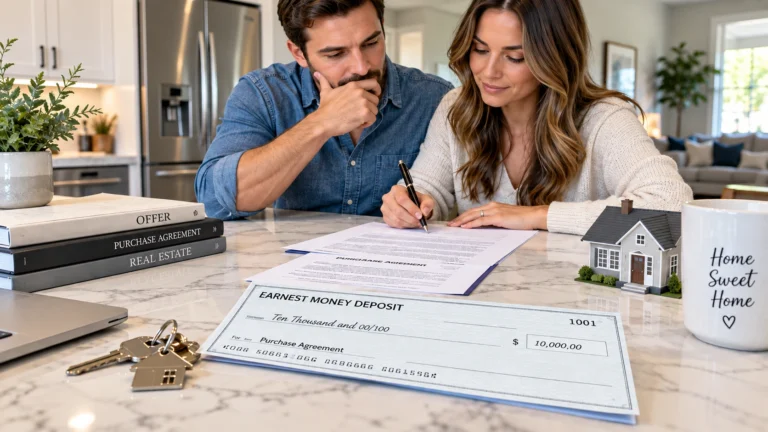
Home Buying Stress: Why It Happens and How to Manage It

Home buying stress often comes from having to make expensive, personal decisions before every detail is certain. You may be worried about what you can afford, whether your offer will be accepted, what an inspection might uncover, or whether your mortgage will be ready for closing.
You cannot control every part of the purchase, but you can make the next decision more manageable. Start by identifying the specific source of pressure, checking what is actually known, setting limits you can live with, and asking the right person one clear question at a time.
The goal is not to eliminate every uncomfortable feeling. It is to make a sound housing decision without letting urgency or uncertainty make the decision for you.
Why Is Buying a Home So Stressful?
Buying a home combines several forms of pressure that do not always move together. A property may feel right for your household while the financial commitment feels intimidating.
A seller might want a quick answer before you have finished weighing the risks. Even after an offer is accepted, financing and property-related questions can remain unresolved.
Common sources of stress include:
- Financial responsibility. A purchase may involve a large upfront payment, long-term mortgage payments, taxes, insurance, repairs, and expenses that are difficult to predict precisely.
- Uncertain outcomes. You can prepare an offer or mortgage application carefully and still be affected by a seller’s decision, lender requirements, inspection findings, or appraisal results.
- High personal expectations. A home may represent stability, family plans, independence, or a major life milestone, making each setback feel more consequential.
- Too many decisions at once. Listings, neighborhoods, financing choices, contract provisions, and competing opinions can make it difficult to identify what matters most.
- Deadlines controlled by other parties. Sellers, lenders, inspectors, insurers, and closing professionals may each have tasks that affect your timeline.
These pressures can coexist with excitement. They also do not mean every buyer experiences the process in the same way.
The practical question is whether a particular worry points to a fact you need to verify, a boundary you need to set, or support you may need beyond the real estate transaction.
Home Buying Stress at Each Stage
Stress can change as the purchase moves forward. Rather than treating the entire process as one overwhelming task, identify the stage where you currently need information.
Preparing Your Budget and Financing
Before making an offer, you may worry about your credit, savings, mortgage eligibility, or the size of the monthly payment. The gap between what a lender might approve and what your household can comfortably spend deserves attention.
Review the expected total housing cost, not just principal and interest. Property taxes, homeowners insurance, applicable mortgage insurance, association fees, utilities, maintenance, and emergency savings can all affect your comfort with a particular price.
The Consumer Financial Protection Bureau’s home affordability guidance recommends considering these expenses and preserving a financial cushion.
Mortgage preapproval can help establish an initial financing range, but it is not a promise of final loan approval. Our Mortgage Preapproval guide explains that distinction in more detail.
For your immediate stress, ask the lender which information has been reviewed and what conditions remain.
Searching for Homes and Comparing Choices
Repeated showings and listing alerts can make every property feel like a decision that must be made immediately. Comparing homes also becomes harder when one has a better location, another has lower monthly costs, and another needs fewer repairs.
Separate essential requirements from preferences before comparing listings. For example, an accessible entrance or a workable commute may be essential to your household, while a particular countertop finish may not be.
Limit the number of properties you compare at one time and write down the evidence behind your preferences.
A useful question is not simply, “Which house do I like most?” It is, “Which home best meets my essential needs without crossing my financial and practical limits?”
Making Offers and Handling Rejection
An offer can feel personal, especially after you have imagined living in the property. A rejected offer or counteroffer may be disappointing, but neither proves that you made the wrong decision.
Before responding, ask your agent what is actually known about the seller’s response, relevant market evidence, and your available options.
Do not increase your price, reduce protections, or change a deadline solely to escape the discomfort of uncertainty. Your offer should still fit your budget and your understanding of the contractual risks.
You may not be able to control a seller’s decision. You can control how you evaluate your next offer.
Inspections, Appraisals, and Unexpected Findings
Once a contract is signed, the stress may shift from finding a house to discovering something that could affect its condition, value, or affordability. Inspection reports can contain unfamiliar terminology, and an appraisal may not match the agreed purchase price.
First clarify what the finding actually says. An inspector’s observation, an estimate from a qualified specialist, and a lender’s appraisal serve different purposes.
Neither an inspection concern nor a lower appraisal automatically creates the same remedy in every transaction.
For deeper explanations, use our Home Inspection Checklist for Buyers and Home Appraisal guide. Discuss the specific finding, purchase agreement, financing requirements, and relevant deadlines with the appropriate professionals before deciding what to do.
Mortgage Underwriting and Closing
Even with an accepted offer and preapproval, a lender may ask for updated income records, asset documentation, insurance information, or other items during underwriting. A request for another document is not, by itself, either a loan denial or proof that closing is guaranteed.
Keep one list of outstanding requests, who is responsible, and when each response is due. If you receive a Loan Estimate, review the expected payment, loan terms, closing costs, cash to close, and any figures that differ from what you discussed.
The CFPB Loan Estimate explainer shows where these details appear and what to ask the lender.
For most mortgage loans covered by the federal Closing Disclosure rule, the lender generally must ensure that you receive the disclosure at least three business days before closing.
Specific exceptions and timing rules apply. Review the figures rather than assuming that receiving paperwork means every issue is resolved. The CFPB Closing Disclosure explainer identifies the key items to check.
If a closing date becomes uncertain, ask your lender and closing contact what remains open, who can resolve it, and whether any contractual deadline needs professional attention. Our guide to what happens after an offer is accepted on a house covers the detailed transaction stages.
Identify What Is Making You Anxious
A vague thought such as “Everything about buying this house is stressful” is difficult to act on. A more specific statement can point toward useful information.
Try writing down five things:
- The stressor: What exact event or decision is troubling you?
- What you know: Which facts have been confirmed by a document or the responsible professional?
- What remains uncertain: Which outcome or detail is still an assumption?
- What you can do: What question, comparison, boundary, or document review is within your control?
- Who and when: Who can provide the next answer, and is there a genuine deadline?
For example, suppose you are afraid of losing your earnest money after an inspection reveals a problem. You may know that the inspector documented an issue, but not yet know what your contract permits or whether further evaluation is needed.
Your next action is to get the relevant provision and deadline clarified by your agent or a qualified local attorney when legal interpretation is needed, not to assume the deposit is either lost or fully protected.
This exercise is a decision-organizing tool, not a mental health screening test. It is most useful when it turns one broad worry into a specific question you can responsibly resolve.
Practical Ways to Manage Home Buying Stress
Set a Financial Boundary You Can Sustain
Decide what total monthly housing payment and upfront cash requirement you are comfortable carrying alongside the rest of your life.
Compare that boundary against realistic estimates for the property, including taxes, insurance, maintenance, and the savings you would retain after closing.
A lender’s maximum loan amount is not a recommendation that you borrow every available dollar. If an offer requires you to eliminate your emergency cushion or rely on optimistic assumptions about future income, the resulting pressure may be a signal to revisit the purchase price or timing.
Separate Must-Haves From Preferences
Choose a small set of requirements that directly affect suitability, such as necessary space, accessibility, location, or a manageable ownership cost. Keep a separate list of features you would enjoy but could live without.
Then compare homes against the same criteria. This reduces the temptation to change your standards with every appealing listing or comment from someone else. It also gives your agent more specific direction.
Reduce Decision Overload
You do not need to follow every listing alert or obtain a new opinion from everyone you know. Agree on a practical search schedule, revisit your priorities when new evidence appears, and avoid repeatedly reopening decisions that are already supported by adequate information.
If you are purchasing with a partner or another household member, discuss your financial ceiling, essential requirements, and circumstances in which either of you would want to pause.
A shared decision rule can be more useful than trying to reach perfect certainty about every property.
Ask for Facts Instead of Guarantees
A useful question to your agent is, “What does this contract require us to decide, and by when?” A useful question to your lender is, “What conditions are still outstanding, and what could change our estimated payment or closing date?”
These questions invite specific answers. Requests such as “Can you promise everything will work out?” cannot remove the ordinary uncertainty of a transaction. Ask professionals to explain what they know, what they are still checking, and when you should expect an update.
Keep Deadlines and Documents in One Place
Maintain a secure checklist of contract dates, lender requests, inspection follow-ups, insurance tasks, and closing questions. Record the person responsible for each item and the date of the latest response.
Store sensitive financial documents securely and confirm any changed payment instructions through an independently verified contact method.
Organization does not guarantee a smooth closing, but it can make it easier to distinguish an overdue action from an issue that someone is already addressing.
Protect Time Away From the Search
It is reasonable to schedule breaks from listings and transaction messages when no immediate deadline requires action. Sleep, regular meals, physical activity, and conversations with supportive people remain relevant during a demanding purchase.
The CDC’s stress-management guidance recommends these kinds of general wellbeing habits.
Breaks should fit the actual transaction. If a contract deadline is approaching, first confirm what action is required and who will handle it. Rest is valuable, but it should not be mistaken for permission to ignore contractual or financial obligations.
Homebuying Stress Map: Common Pressure Points and Next Actions
Use this table to find the issue closest to your situation. The aim is to identify one useful action, not to complete every task at once.
| Homebuying stage | Common source of pressure | What to verify | One manageable next action | Who can help |
|---|---|---|---|---|
| Budget and preparation | Fear of taking on an unaffordable payment | Total housing cost, cash needed, remaining reserves | Set a personal payment and cash limit | Lender, qualified housing counselor, financial professional |
| Home search | Too many choices or fear of missing out | Essential needs, comparable costs, property trade-offs | Compare a short list against the same criteria | Buyer’s agent, household decision-makers |
| Offer and negotiation | Rejection or pressure to increase an offer | Seller response, market evidence, contract terms | Recheck the price ceiling before responding | Buyer’s agent; attorney if legal interpretation is needed |
| Inspection or appraisal | Unexpected property condition or value issue | Actual report, specialist findings, relevant deadlines | Ask which finding needs clarification first | Inspector, appraiser or lender, buyer’s agent |
| Underwriting and closing | More document requests or shifting dates | Outstanding conditions, costs, cash to close, closing status | Ask for an updated written task and date list | Lender, title or closing professional |
The right next step depends on your contract, financing, location, and circumstances. A table cannot determine your legal rights or guarantee that a transaction will close.
What You Can Control and What You Cannot
It is useful to separate a decision you make from an outcome that another party must decide. Confusing the two can lead to unnecessary pressure or overconfidence.
| Situation | What you can control | What you cannot guarantee | Sensible response |
|---|---|---|---|
| Asking price or competition | Your maximum offer and acceptable terms | Whether the seller accepts | Keep the offer within your limits |
| Mortgage preapproval | Accurate information, prompt responses, comparison of terms | Final underwriting approval | Ask the lender which conditions remain |
| Home inspection | Obtaining and reviewing findings, requesting qualified evaluation | A defect-free home or a particular seller concession | Review the report and contract before acting |
| Appraisal | Asking the lender about the report and possible next steps | The appraised value or financing result | Clarify the actual gap and available options |
| Contract deadlines | Recording dates and seeking timely guidance | Another party’s agreement to change a date | Escalate a deadline concern promptly |
| Closing schedule | Completing assigned tasks and communicating early | That every party finishes on the planned date | Confirm outstanding items and contingency plans |
A control is not a guaranteed result. You may prepare thoroughly and still face a rejected offer, a financing problem, or a delayed closing. That is why a sound buying decision includes both a plan and boundaries you will maintain if the facts change.
When Offers Fall Through or Problems Appear Under Contract
After a rejected offer, give yourself room to be disappointed before treating the outcome as evidence that you must bid more aggressively next time.
Review whether your offer reflected your financial ceiling and the information reasonably available when you made it. A different property may be a better fit, but no one can promise when it will appear.
Under contract, distinguish the emotional reaction from the transaction question. An inspection concern may need a specialist’s assessment.
An appraisal gap may affect the lender’s financing decision. An unresolved title issue may require the closing team or an attorney. A revised document request may simply mean underwriting is still underway, but the lender must confirm its meaning.
For any material problem, write down the finding, relevant document, deadline, decision-maker, and the choices that actually exist. Do not assume you can cancel, renegotiate, recover earnest money, or extend closing unless the contract, applicable law, and other parties’ actions support that outcome.
You can be concerned about a problem without deciding its significance before you have the facts.
Home Buying Anxiety, Depression, or Panic: When More Support May Be Needed
Homebuying stress and clinical mental health concerns are not interchangeable. A demanding transaction can coincide with persistent anxiety, depressed mood, or panic-like experiences, but it would be inaccurate to assume that buying a home caused a disorder or that every distressed buyer has one.
When Worry Feels Like More Than Ordinary Stress
It is common to feel nervous before an offer, inspection, or mortgage decision. Stress often has a recognizable external source, while anxiety can continue even when the immediate pressure is absent. The National Institute of Mental Health’s guidance on stress and anxiety explains this distinction.
If worry becomes persistent, interferes with sleep or ordinary activities, or makes it difficult to function outside the purchase, consider speaking with a qualified healthcare or mental health professional. A real estate agent or lender can clarify transaction facts; they cannot diagnose an anxiety condition.
Depressed Mood During a Difficult Buying Experience
A lost opportunity, prolonged uncertainty, or financial disappointment may leave someone feeling discouraged or sad. Those feelings do not, by themselves, establish clinical depression.
Persistent low mood, loss of interest, or other changes that affect daily life deserve appropriate professional attention, whether or not a home purchase is involved.
The NIMH’s depression information describes symptoms and explains when to seek assessment. Do not rely on a real estate decision or a completed closing as a substitute for care if you are concerned about your mental health.
Panic-Like Symptoms and Urgent Physical Concerns
Intense fear can occur alongside a racing heartbeat, dizziness, chest discomfort, or breathing difficulty. These sensations cannot be safely identified as a panic attack from a real estate article. The NIMH’s information about panic attacks and panic disorder distinguishes an individual episode from a condition requiring professional assessment.
If you experience new or severe chest pain, significant breathing difficulty, or other potentially urgent medical symptoms, seek immediate medical evaluation rather than assuming anxiety is the cause. Repeated or disruptive episodes should also be discussed with an appropriate healthcare professional.
If you or someone else is in immediate physical danger, call 911. If you are in an emotional crisis or having thoughts of self-harm in the United States, you can call or text 988 for crisis support. These crisis resources are not routine responses to ordinary homebuying worries.
Should You Pause or Reconsider the Purchase?
Sometimes the next responsible step is to slow the search, revisit your budget, or ask for professional guidance before committing further.
A pause does not necessarily mean abandoning homeownership. It can create space to decide whether the specific property and transaction are still suitable.
Consider a closer review when:
- The total housing payment would be difficult to sustain after accounting for taxes, insurance, maintenance, other debt, and ordinary living expenses.
- Upfront cash needs would leave you without reserves you consider necessary for emergencies or foreseeable repairs.
- You feel pressured to offer more or waive protections without understanding the financial and contractual consequences.
- A material inspection, appraisal, title, or financing issue remains unexplained as an important deadline approaches.
- Household decision-makers disagree about an essential requirement, spending limit, or level of risk.
- Stress, low mood, or panic-like symptoms are significantly interfering with everyday functioning or your ability to make an informed decision.
If you have not entered a contract, reassessing your timeline and price range may be relatively straightforward. If you have signed a purchase agreement, do not simply miss deadlines or assume that pausing the search cancels your obligations.
Ask the relevant real estate professional or a qualified attorney to explain your options under the agreement and applicable law. Where financing is involved, also consult your lender about the consequences of any proposed change.
The purpose of reassessment is to make a deliberate decision, not to promise that waiting will improve prices, mortgage rates, or your emotional wellbeing.
First-Time Homebuyers: Questions Worth Asking
If this is your first purchase, unfamiliar language and procedures can add to the pressure. You do not need to become a mortgage, construction, and contract specialist overnight. You do need clear answers to the questions that affect your decision.
Use this short communication checklist and record the answer, person responsible, and date of the next update:
Ask your real estate agent:
- What decision do I need to make next, and which deadline controls it?
- Which contract terms or contingencies should I understand before agreeing to a change?
- Which property concerns need an inspector, contractor, insurer, or attorney rather than a guess?
Ask your lender:
- Which approval conditions remain, and what documents are still required?
- What is the current estimated total monthly payment and cash to close?
- What could change the quoted terms, rate-lock status, or closing timeline?
Ask the title or closing professional:
- Which settlement documents, title issues, or closing tasks are still outstanding?
- When should I expect final figures, and how do I verify legitimate payment instructions?
- Who should I contact if a required document or scheduled date changes?
Ask yourself or your household:
- Does this home meet our essential needs at a cost we can responsibly carry?
- Are we making this decision because the evidence fits, or mainly because we fear losing the opportunity?
- What unresolved issue would make us stop and seek more advice before proceeding?
For a broad view of each purchase stage, use our Buying a Home resource center. The complete How to Buy a House guide provides the procedural steps separately.
The Bottom Line
Home buying stress often becomes more manageable when you stop treating the entire purchase as one decision and focus instead on the specific unknown in front of you.
Identify the concern, verify the relevant facts, decide what remains within your control, and ask the person responsible for the next answer.
Keep a financial boundary you can sustain, understand the contractual and mortgage consequences before agreeing to changes, and do not mistake an urgent feeling for a deadline that has actually been confirmed.
Some uncertainty will remain. A rejected offer, unexpected property finding, or delayed closing does not automatically mean that you have failed, just as an accepted offer does not guarantee the purchase will finish as planned.
If emotional or physical symptoms become persistent, severe, or disruptive, seek appropriate healthcare support alongside the practical real estate guidance you need.
The useful next step is simple: name your main stressor, verify one material unknown, and choose one responsible action. A sound homebuying decision does not require perfect certainty; it requires information, reasonable limits, and an understanding of the risks you are accepting.